
The Majdal al-Shour document, concluded in April 1888, is considered one of the most important documents in the history of Jabal al-Arab, after which what became known as the “Ammiyya Revolt” broke out.
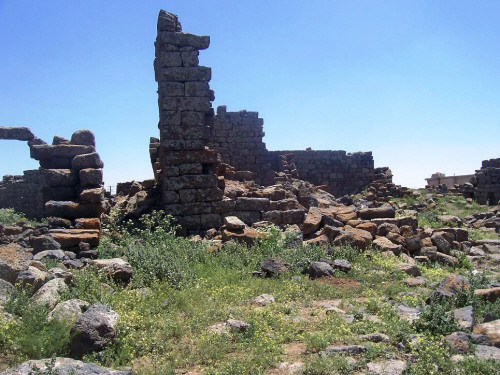
In April 1888, the peasants of Orman, Malah, Imtan, and Al-Huwayya called for a meeting to be held in the ruins of Al-Majdal, which stands centrally between the three villages of Malah, Orman, and Imtan, for the purpose of consultation regarding the condition of the peasants and the tyranny of the sheikhs allied with the Ottomans. Since that time, the site has been called (Majdal al-Shour).
A number of peasants attended the Al-Majdal meeting, where they discussed the conditions in the Mountain, the reasons for gathering, and the peasant measures capable of altering those conditions. In conclusion, the attendees drafted their demands in the document or manifesto dated 15 Sha'ban 1306 AH, corresponding to April 1888.
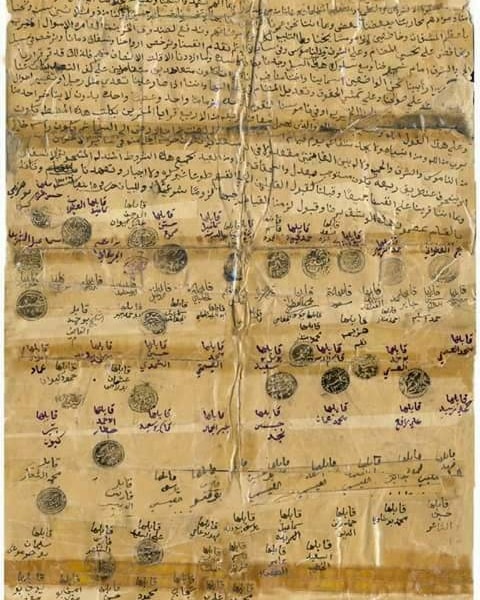
Below is the full text of the declaration, along with a written clarification of what appeared in the document and the attached image, presented verbatim:
“Praise be to God alone.
The reason for drafting this is the fabrications, greed, and transgressions committed against us by our sheikhs, and because they have deliberately tormented us and expelled us from our lands and from the entire district without any transgressions on our part, their intent being to turn us against one another in conflict.
And whereas we have built these villages, inhabited them, and incurred enormous losses for them over thirty years through the greatest hardships, remaining obedient to the commands of our sheikhs, complying with everything to their satisfaction, paying the amiri taxes into the treasury chest, upholding the preservation of public order (the system – author's note), honor, and dignity under all circumstances; and whereas we have offered ourselves, risked our lives, and shed our blood in the path of zeal and honor before our sheikhs, yet despite pursuing this path, we found our endeavors in vain and received nothing from them but a lack of fairness; therefore, our resolution has been set and our opinions united—we, whose names and seals appear below—to enter into a covenant of mutual support to halt the transgressions against us, protect our interests, and uphold rights and the reform of the system to the utmost degree.
And should any aggression befall us, such as displacement, alteration of conditions affecting our habitations, infringement on our benevolent interests, or violation of our honor, we shall rise as one hand, under one reins, and as one united body, without anyone among us lagging behind.
Upon this word stand God and Shu'ayb, the Prophet of God. Whoever fails to support their kinsmen from the four villages that acknowledged the drafting of this protocol shall be disowned by God and His prophets, shall find no intercession on the Day of Resurrection, but rather shall bear a curse rising from the earth to the heavens; their head shall be void of dignity, honor, and zeal, having no seat among the honorable nor any ascent to heaven, and their womenfolk shall be of greater stature than them under all circumstances. Whoever changes or deviates from the path of their kinsmen shall rightfully incur from God and mankind the penalty under all these humbling terms laden with trouble.
And whereas we have all affirmed this upon ourselves and accepted it as those who voluntarily accept binding obligations without coercion or compulsion, and we have committed and tasked ourselves with fulfilling the substance of this document willingly and approvingly, we have bound ourselves to adhere to it by legal obligation.
For declaration, drawn up on 15 Sha'ban 1306 AH, corresponding to April 1888.
Hussein Saymou'ah, Qasim Ghazaleh, Khalil Kiwan, Ismail al-Atwani, Abu Hussein Kiwan, Hamad al-Zughayer, Najm al-Atwani, Hussein Tarbayh, Yousef al-Safadi, As'ad Azmi, Hamad Kiwan, Qasim al-Hamoud Na'im, Zain al-Din Rashid, Hamad al-Najm Jarbou', Ismail al-Dibs, Ibrahim al-Jarmaqani, Ismail al-Shuraiti, Muhammad al-Atwani, Qasim al-Halabi, Yousef al-Halabi, Mansour al-Da'bal, Sayyah Abu Hamid, Muhammad Abu Dehn, Hussein Azmi, Ali Rizq, Rustum Mas'oud, Suleiman al-Qantar, Muhammad Jaber, Hussein Badawi, Hamad Saymou'ah, Yousef al-Jaghrami, Abu Hamad al-Qadi, Mahmoud Mundhir, Hazimah Na'im, Ahmad Mundhir, Hamad al-Salim, Hussein al-Shamandi, Othman Abu Ras, Muhammad Mula'ib, Hamad Kiwan, Murad Imad, Muhammad al-Aysami, Hussein Najd, Jabr al-Jammal, Qasim Abu Sa'id, Khattar al-Ahmad, Bashir Kiwan, Muhammad Nu'man, Ali Rafi', Ali Rashid, Muhammad al-Sha'ar, Faris al-Dbeisi, Yousef al-Aysami, Faris Abu Qansouh, Amin al-Aysami, Salman al-Aysami, Mahmoud Jaber, Fahd al-Halabi, Suleiman Abu Harmoush, Faris al-Sha'ir, Ali Sa'id, Fahd Abu Assi, Yousef Jawdiyah, Ismail al-Karidi, Hamad Zain al-Din, Muhammad Abu Ghawi, Hussein al-Sha'ir, Yousef Abu Maghdab, Hussein Du'aybes, Mahmoud Abu Maghdab, 'Ajjaj Abu Maghdab, Ali Abu Maghdab, Abu Yousef al-Khatib, Qasim Aziz, Amer al-Safadi, Hamad Qutrub.
The Ammiyya Revolt resulted in hundreds of casualties; however, it concluded with an agreement reducing the village sheikhs' (feudal lords') land ownership from one-quarter of the land to one-eighth.
It is worth noting that the Majdal al-Shour document was deposited at the time with Sheikh Abu Ahmad Qasim Abu Sa'id in the village of Al-Huwayya, then with his son Sheikh Abu Hamoud Salman Abu Sa'id, and is currently held by his grandson, Jamil Abu Sa'id, the former mukhtar of Al-Huwayya.