


Under the patronage of the head of the Progressive Socialist Party, MP Taymour Jumblatt, represented by MP Marwan Hamadeh, the National Library of Baakline and the Kufa Academy (Netherlands) held a seminar on the book “The Unitarian Sage Kamal Jumblatt in his Indian Manifestations” by the researcher Professor Mohammed Saeed Al-Turaihi. Speakers included Dr. Fouad Jean Nassif and Dr. Nasser Zeidan, with the session moderated by the Vice President of the Association of Friends of Kamal Jumblatt, lawyer Ghada Jumblatt.
The seminar was attended by clergy, member of the Druze Unitarian Community Council Mr. Osama Zobian representing the Sheikh Aql Dr. Sami Abi Al-Muna, Sheikh Youssef Al-Ashkar representing the Al-Irfan Al-Tawhidia Foundation, party, municipal, military and security officials, cultural and educational figures, and a large crowd of interested attendees who filled the lecture hall at the National Library.
Jumblatt
Following the Lebanese national anthem, the opening remarks were delivered by lawyer Ghada Jumblatt, who touched upon the world of the sage and unitarian Jumblatt: “It is the world of asceticism and monkhood, the world of liberation from the shackles of materialism, transcending objectification, and walking the path of light leading to the Truth—God. For him, the Truth is the cause and the ultimate goal, and the standard for everything. A human cannot grasp the Truth unless they strip themselves of the ego and detach from their self; therefore, the Master considered Sufism to be the path of salvation that frees him from everything hindering the discovery of his human essence.”
She added, “The ascetic Master practiced his Sufism in his private life. His room was limited to a mattress on a mat, a rug, prayer beads, a vessel for incense, a jug and a clay jar, and candles everywhere. His food was limited to the bounties of Mother Nature. In his room, he would purify himself of all that is tangible, recite his prayers in the presence of nature, and unite with existence.”
Regarding the book discussed at the seminar, Jumblatt said, “It is an intellectual synthesis of research and articles that addressed the Master's biography and his influence by Indian philosophy. The Master combined Unitarian Sufism with the Indian philosophy he used for guidance. He considered 'Hinduism as a way of life, a general direction in thinking, belief, and behavior, which gathers various types of collective and individual sects, like a huge, wide river that incorporates into its waters all the streams, brooks, and rivers that flow into it.'”
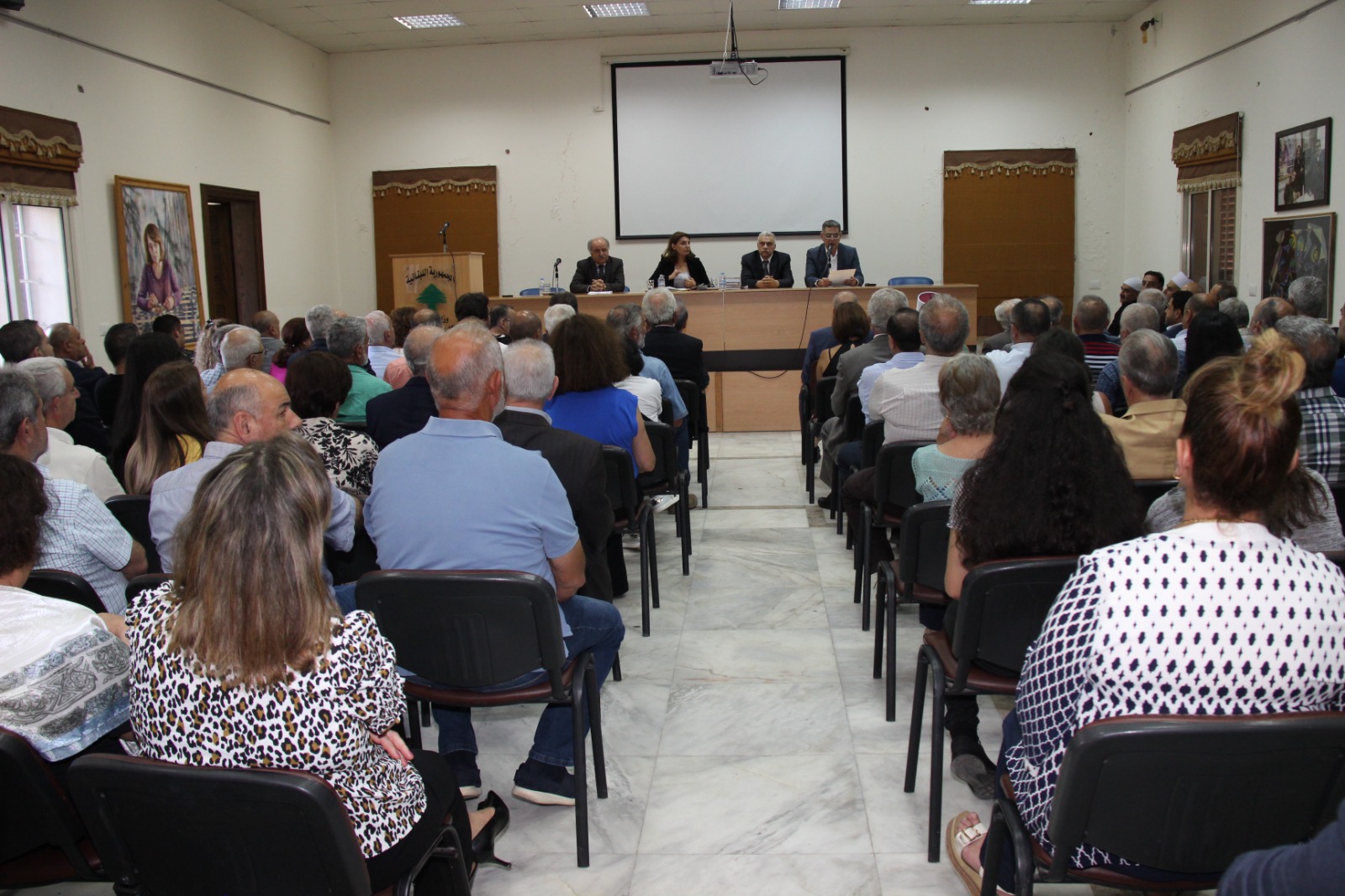
Nassif
Dr. Nassif began his intervention by asking the attendees to observe a minute of silence to connect with the atmosphere of peace and knowledge that originates from India, and to send it to the children, women, and families in Gaza who have been suffering for several months in ways beyond imagination and endurance, explaining that “Kamal Jumblatt incorporated this atmosphere into his daily life, fed from it, and offered it to others.”
He pointed to Kamal Jumblatt's relationship with Indian spirituality, its traditions, philosophy, and paths, which Professor Al-Turaihi's book touched upon, summarizing faithfully and with successful arrangement the most prominent information and testimonies available regarding the visits, connections, activities, and experiences of “Kamal Jumblatt” with spiritual India. The book also includes the most important things he wrote, translated, and presented.
Nassif mentioned the distinguished Indian Master, Swami Chidananda, a spiritual friend of Master Kamal Jumblatt, who used to visit Lebanon regularly in the seventies and eighties and stay in the town of Baakline.
He then addressed the three headings that “Kamal Jumblatt” applied in his approach to Indian spiritual practices, namely: “First, personal experience: the motive in our religious path should not be formal or superficial imitation of what our mind understands as a spiritual practice, or what is explained by writings or the words of teachers and accepted by our minds as givens. The lesson is in the personal experience through the heart and soul, so this experience forms an experience unique to the individual.”
“Second, practice under the supervision of a spiritual teacher (Guru). According to the Hindu spiritual tradition, the first thing a sincere and serious spiritual seeker does is prepare themselves to meet their own spiritual teacher. It is the duty of the student to be completely open to him, which is translated by showing total respect for the person of the Master (the Guru), reaching full submission to his teachings, his directions, his instructions, and his will... Kamal Jumblatt followed this behavior towards his Master, Sri Atmananda, with remarkable idealism, from his first meeting with him in 1951 until Atmananda left this world in 1959. Afterward, he referred to him in his writings as 'my master and mentor, my Lord, the Sage Sri Atmananda,' and dedicated his most important poetic and Sufi works to him.”
“Third, practice motivated by the highest Dharma. Genuine and valid spiritual practices have a motive behind them that is outside the Ego and its complex and cunning games. In healthy practice, the internal atmosphere is an atmosphere of dialogue with the Lord and serenity with the Self. Kamal Jumblatt realized the importance and capabilities of this clever and skilled Ego, so he always sought to ensure that his motive in his various yogic practices remained the Highest Dharma, the duty and the higher path, which is the purification of the self and the soul, and the realization of the Eternal Self.”

Zeidan
Dr. Zeidan believed that “The book sheds light on the uniqueness of Kamal Jumblatt, for he was an idealist who lived realism in its details, especially through his advanced leadership role, and in his pursuit of the details of political and partisan life and its local, Arab, and international complexities. Even the idea of establishing the Progressive Socialist Party in 1949 came in harmony with the visions he believed in. The party's charter considered that the human being is the goal of any human institution and action. Therefore, it is not permissible to use this human as a means to achieve unrestrained profitability, as happens in some Western capitalist countries, nor to oppress and conquer them for the sake of power or to implement expansionist projects or to increase influence, as happens with the tormented people of Palestine. It is also not permissible to restrict their freedoms as was happening in some countries that applied communism against its intentions, just as in some Arab countries that drifted towards tyranny and turned oases of goodness and authenticity into a large prison. He called for achieving a more humane socialism that is consistent with human nature, and working to achieve this goal, in his view, transcends the importance of any other work because it serves the human being.”
He pointed out that “when 'Kamal Jumblatt' presented the idea of abandoning politics to his Master, the sage Shri Acharya, Acharya rejected this option and wished for him to continue playing his national and international role, because in doing so, he provides a model for humanizing politics and enriching it with intellectual and spiritual dimensions, considering it the most honorable profession because it relates to leading people and defending their interests, not exploiting them and pushing them towards misery and destitution. One can notice Jumblatt's consideration of participating in the restoration work of the houses of the Chouf town of Bater, which were damaged in the 1956 earthquake, for example, as part of a movement with cosmic repercussions, or that it is linked to the supernatural energy that imposes realities as it imposes the way of dealing with them at the same time.”
Zeidan said, “The researcher in Indian philosophy, Mrs. Nihad Abu Ayyash, who was in India on March 16, 1977 (p. 33), states that the Master Shri Acharya canceled his busy religious program on that day and asked for torches to be lit when he learned of the assassination of Kamal Jumblatt, which had not happened for any politician before, except upon the martyrdom of Mahatma Gandhi in 1948 and during the announcement of the death of the historical leader Jawaharlal Nehru in 1964.”
He continued, “Perhaps researcher Al-Turaihi's description on page 14 expresses the most eloquent expression of the truth of the Unitarian trend in Kamal Jumblatt, as he sees it built on previous intellectual and spiritual experiences, including Indian philosophy and its yogic output, pure Islamic foundations, and liberal Christian tendencies which the French Jesuit monk Pierre Teilhard de Chardin showed in the best scene,” concluding his intervention by expressing thanks to the patron, the publisher of the book, and the attendees.
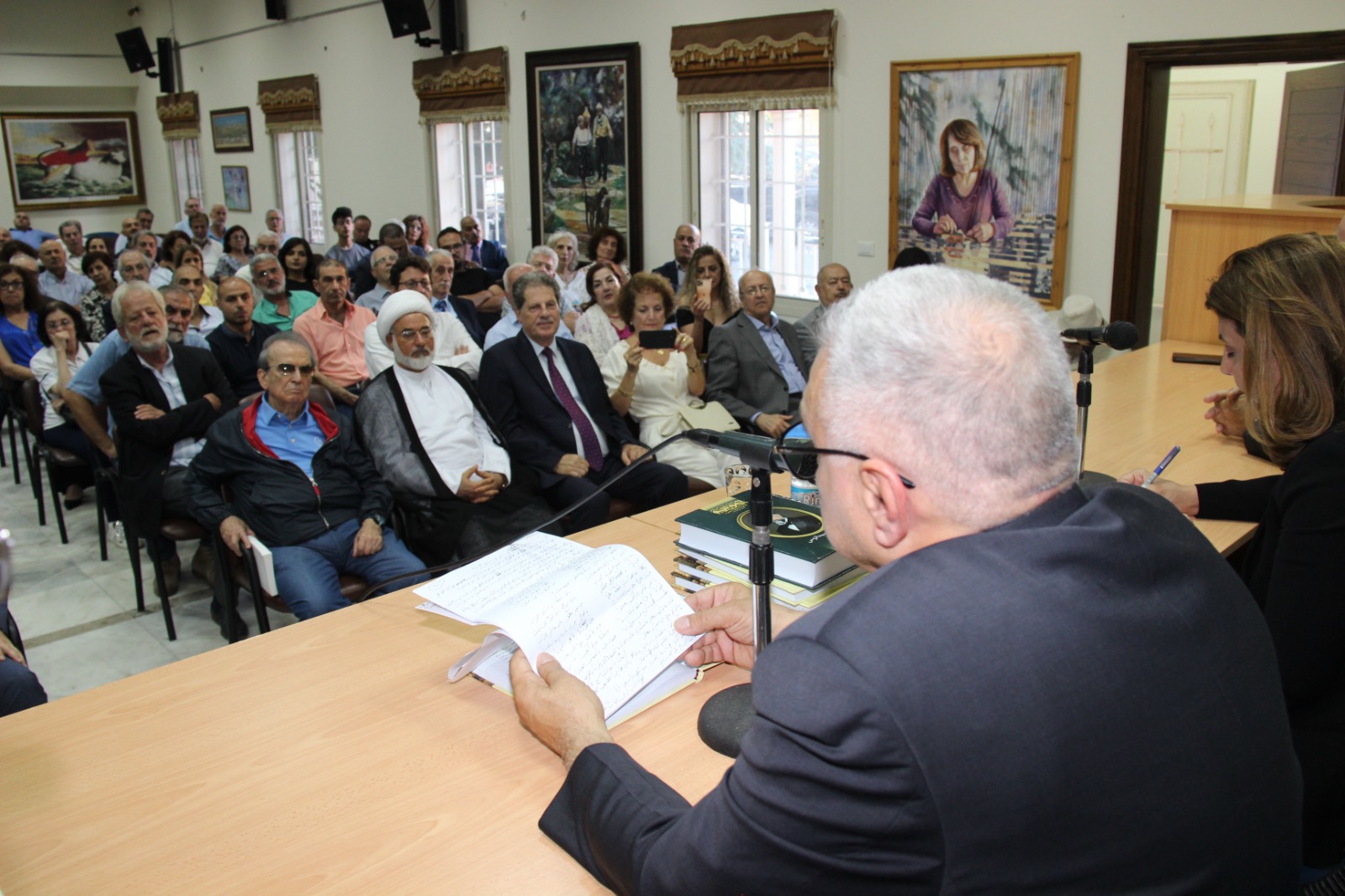
Al-Turaihi
At the beginning of his talk, the researcher Professor Al-Turaihi sent a greeting “to the one who gathered us today in his name, his prestige, and the hidden facets of his virtue in this evening, the Unitarian Sage Kamal Jumblatt.” He continued, “I mentioned Iraq and Lebanon at the beginning of my talk on this pleasant occasion due to the affection and reverence I hold for them in my heart, sharing in established glory and mutual love. Among the signs of this is that two weeks ago, my brother, Professor Dr. Mounir Hamzeh, called me to arrange this meeting, and then Dr. Nasser Zeidan called to confirm. I decided to stay in Baghdad for a few days before traveling to Beirut. It was one of the good coincidences, or call it destiny, that my stay would be in a house opposite Jumblatt Square in the center of Baghdad, so I was happy with this proximity and was optimistic. It happened that I wrote something that crossed my mind from my readings of Jumblatt's thought, especially regarding his high and vast spiritual horizons. I proceeded to browse what we had previously collected in the book issued by the Kufa Academy, which was intended to be a key or an introduction to studying Jumblatt's thought and his interests in Indian philosophical thought. My eyes fell on his picture published on page 12, in which the noble Unitarian Sage appears in the world of the unseen, occupied by the state of being from every other state, appearing sitting on the rug of asceticism, thinking, meditating, and sailing in the worlds of wisdom. This unique snapshot inspired the lines I wrote at that moment, and here they are in my hands, I recite them as they were revealed, in recognition and veneration of the Master of Wisdom, and as a kind memory of his inspired spirit.”
He added, “Indian spirituality imprinted Kamal Jumblatt's intellectual life with what he produced and wrote, just as he followed the path of its wisdom in action and behavior,” noting that “Master Kamal Jumblatt was a seeker of his truth. The truth is the secret of his attachment to India, and his trips there were out of love, passion, and satisfaction of an overwhelming metaphysical desire that dominated his thought and controlled his senses. His spiritual experience in India and his interests in Hindu philosophical thought need in-depth studies. What is between the covers of this book is a key, attempts, and an introduction to studying his Indian manifestations, which I collected to stimulate students of knowledge and truth to delve deeper into it, to study the Sufi side in Jumblatt's spirit, and to manifest his position speaking with the tongue of Unitarianism. He was the ember whose glow never fades through his knowledge, his work, his biography, his journey, his path, and his approach. So peace be upon him in eternity.”
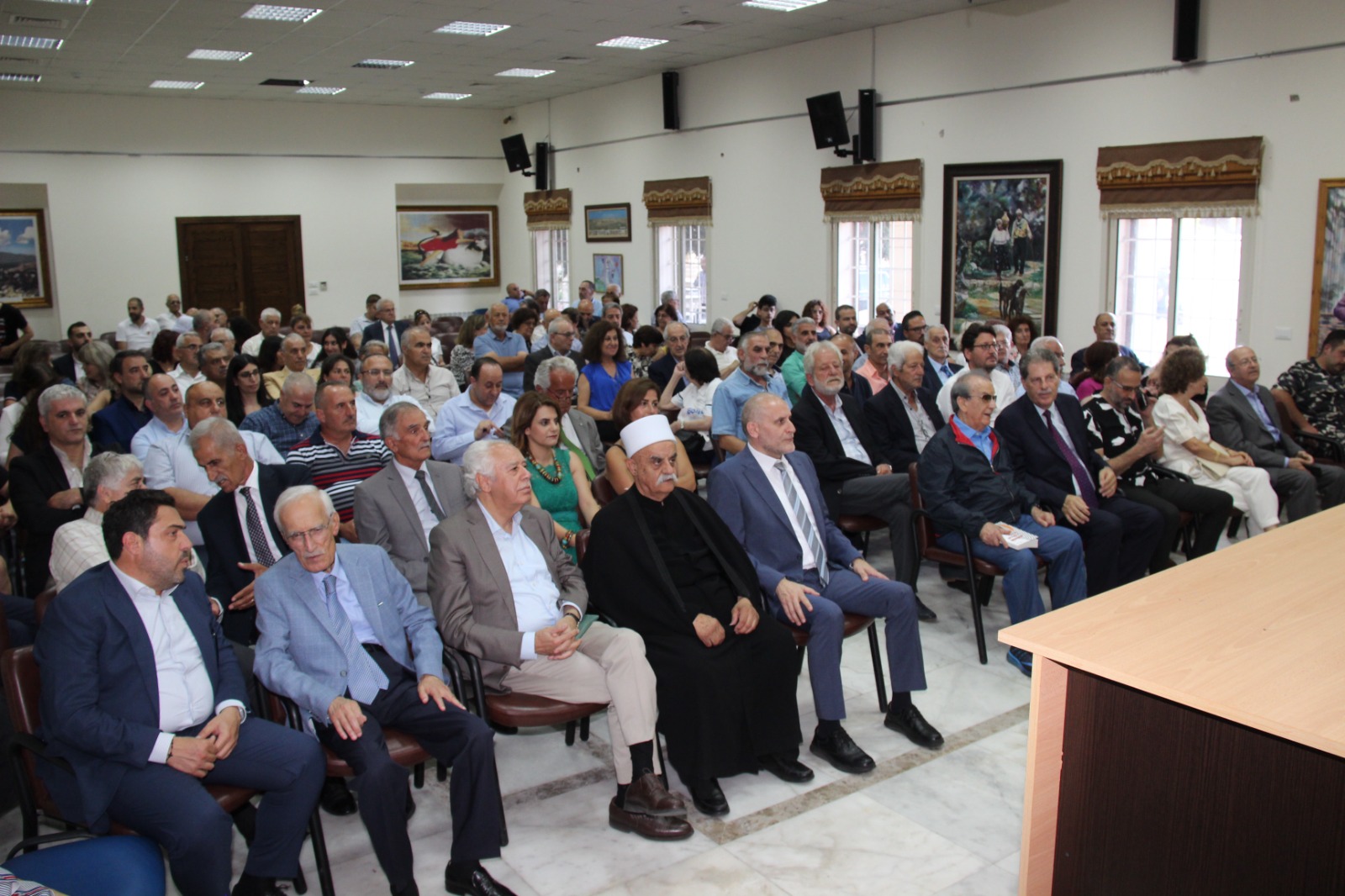
Hamadeh
There was an intervention by MP Marwan Hamadeh, in which he said, “These moments that have brought us together may be among the most important moments and lectures we have attended in this National Library, truly,” expressing his appreciation to the lecturers.
He continued, “It is no coincidence that the book signed by MP Taymour Jumblatt, whom I am honored to represent tonight—and I wish he were present with us tonight to have benefited, as we have, from all this talk about the martyred Master who has always searched for the Truth, and perhaps when he proclaimed it before some Arab rulers, they met him with assassination because he refused to drag Lebanon into the Great Arab Prison.”
Afterward, Hamadeh presented the martyred Master Kamal Jumblatt's book, “Palestine: The Cause of a People and the History of a Homeland,” to Al-Turaihi, saying, “Taymour Jumblatt chose this book from among his grandfather's books, which is perhaps the title of the current phase, to gift to you as a token of friendship and appreciation for your knowledge and your vast awareness of “Tawhid” (Unitarianism) and the dissemination of these ideas that we believe in and hope will lead us to the salvation of Lebanon and the Arab nation.”