
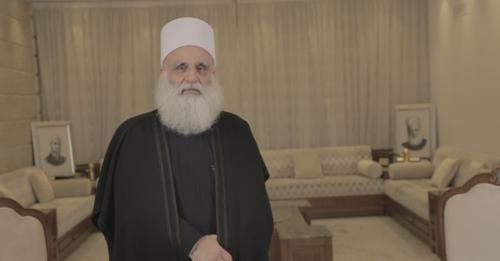
His Eminence the Sheikh Akl of the Unitarian Druze community, Sheikh Dr. Sami Abi Al-Muna, stated that “what happened in Majdal Shams has raised many ambiguities and questions about the identity of those who committed this crime, their motives, and their dimensions. In our view, the matter requires an investigation to confirm who is behind this painful incident. However, hurling accusations at “Hezbollah” or any other party is aimed at inciting sedition, and the political accusation that occurred had a degree of malice, yet we were able to address the matter and contain it by rejecting sedition”.
In an interview with the “Annahar” newspaper regarding the Druze of Palestine and the stance of some who hold Israeli citizenship and serve in the army, he said: “They are not to be envied for the reality they live in. Some feel they must participate in that state and respect its laws, but they are subject to pressures; in the past, their lands were confiscated and those who refused mandatory conscription were thrown into prison. Some deal with the reality as if it is a phase that will end when the occupation ends, while others have refused and endured the pressures. However, Israeli cunning works to strip them of their identity, though this Israeli cunning does not deceive the leaders who know that the Israelis have their own agenda.”
He added: “They know their reality best, and we do not interfere much in their private affairs, but we say they must not lose their history, their compass, and the right direction. Israeli cunning may lead some of them to a place where their identity is scattered and lost, but they must hold on to their identity. Israel may give some administrative and security positions to the Druze, but these positions are feeble in the face of the Jewish Nation-State Law which enshrines a Jewish state. This is a racist state based on an ideology of dominance, hegemony, and a religious view of things that makes them distinguish themselves from all other people.” Regarding the group opposing Israeli citizenship and army conscription, led by intellectuals and politicians such as Said Naffaa and others, Abi Al-Muna commends this intellectual trend and believes that “the idea may bear fruit later. This feeling exists among the majority of the Unitarian Druze; some may go along with and appease reality, but others affirm this identity and emphasize that opposition must remain. This movement is useful in the long term and stirs the feelings of the Unitarian Druze, and we must awaken in them the feeling of holding on to values.”
His Eminence Sheikh Abi Al-Muna pointed to the “Israeli project which calls for the creation of a Druze state,” noting that “Druze leaders like Kamal Jumblatt and Sultan Pasha al-Atrash rejected this project.” However, he says the project “is still present in Israeli thinking, and we reject it and will stand as a formidable barrier against it so it does not materialize, because it constitutes a form of isolation and suicide.” He adds: “There is no acceptance of the idea of a Druze state, but in the midst of the conflict in the region, there may be schemes to lure the Druze into thinking that the safe haven for them is their own state. However, our firm position is the rejection of the idea of establishing this state, for which we see no horizon. The Unitarian Druze in Lebanon, Syria, and Palestine reject this project.” He considered that “a Druze state is a form of suicide,” asking about its goal: “Is the intention to protect Israel's borders? Or to develop our economy? Do we have a large economy? We are strong when we are with others; the umbrella is the state. Some think that we have our own customs and values and if we establish a small state we will protect our society more, but the whole world has become an open village. So, shall we isolate ourselves in a small state and disagree among ourselves?”
Regarding federalism or partition projects, the Sheikh Akl recalled that “Lebanon is a small country. Broad administrative decentralization is good and a necessity for facilitating people's transactions, but I do not advise partition and federalism at all because we want to be united, open, and cooperative.”
Regarding the war in the South between Israel and “Hezbollah” and the Druze position on what is happening, he said: “We are keen on national unity. Repelling Israeli aggression and self-defense are both legitimate matters, and failure to defend oneself is a form of defeatism that encourages the enemy to commit more aggression. However, we link this position to asking the resistance not to drag Israel into a wider war, and we have sensed the wisdom of the resistance leadership and the awareness and respect with which they treat our people in the South region.” Regarding the future of Lebanon in light of the existing political stalemate and the inability to fulfill national obligations, Abi Al-Muna says: “There is a difficult reality we are living in Lebanon, but we must strive for national unity and understanding through constant dialogue and consultation.”
In response to a question, His Eminence Sheikh Abi Al-Muna pointed to the “importance of investing in endowments and the practical steps in this direction, as well as the elections of the Confessional Council and the call for participation, to bring forth the appropriate talents and competencies.”