
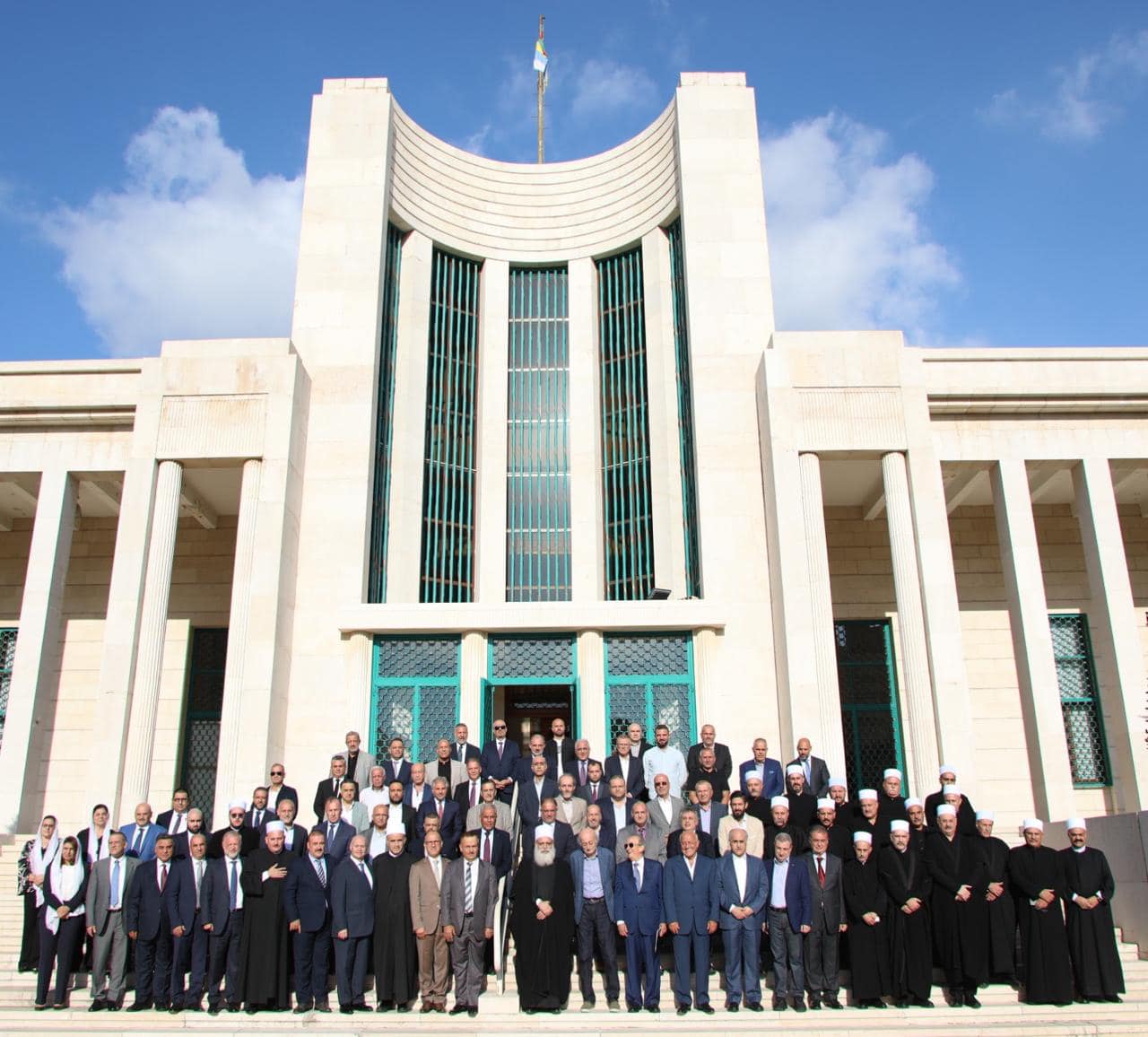
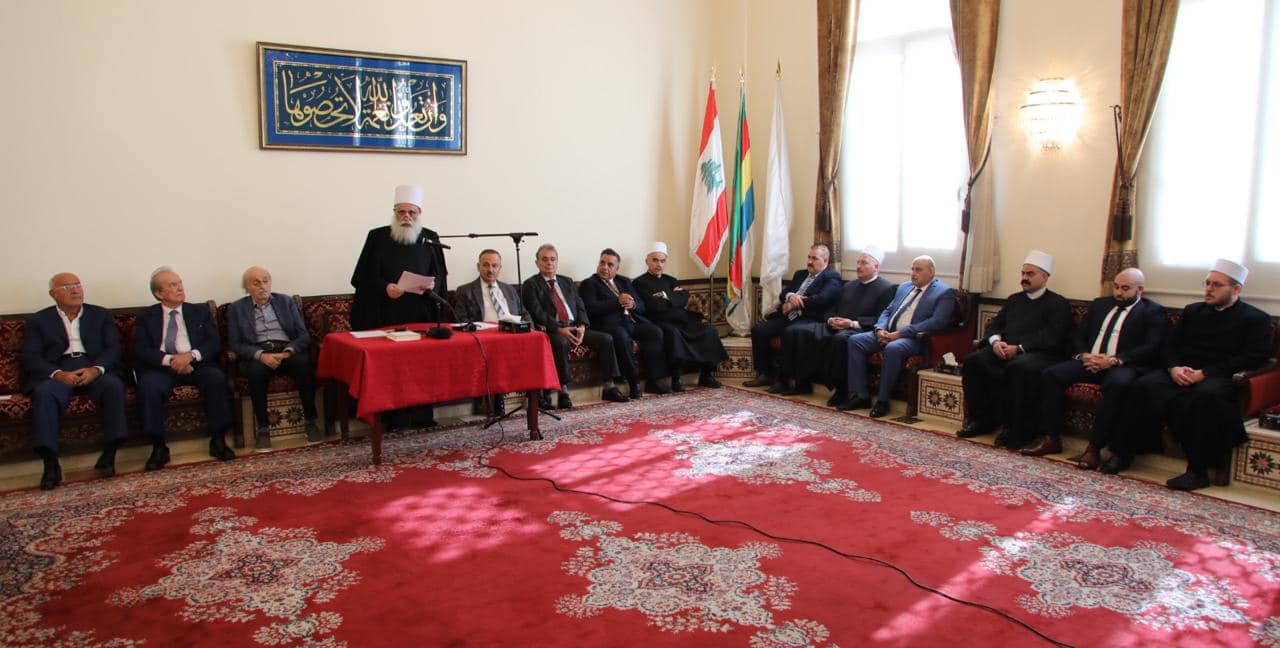
The new General Assembly of the Madhhabi Council of the Druze Unitarian community held its first session following the elections that took place on the 25th of last month. The meeting was held at the community headquarters in Beirut, presided over by His Eminence Sheikh Al-Aql, Sheikh Dr. Sami Abi Al-Muna, and in the presence of leader Walid Jumblatt, Members of Parliament Marwan Hamadeh, Hadi Abu Al-Hassan, Wael Abu Faour, former MP Ghazi Al-Aridi, Constitutional Council member Judge Riad Abu Ghida, Supreme Judicial Council member Judge Afif Al-Hakim, President of the Druze Supreme Court of Appeal Judge Faisal Nasr Al-Din, and religious judges, in addition to the permanent and elected members.
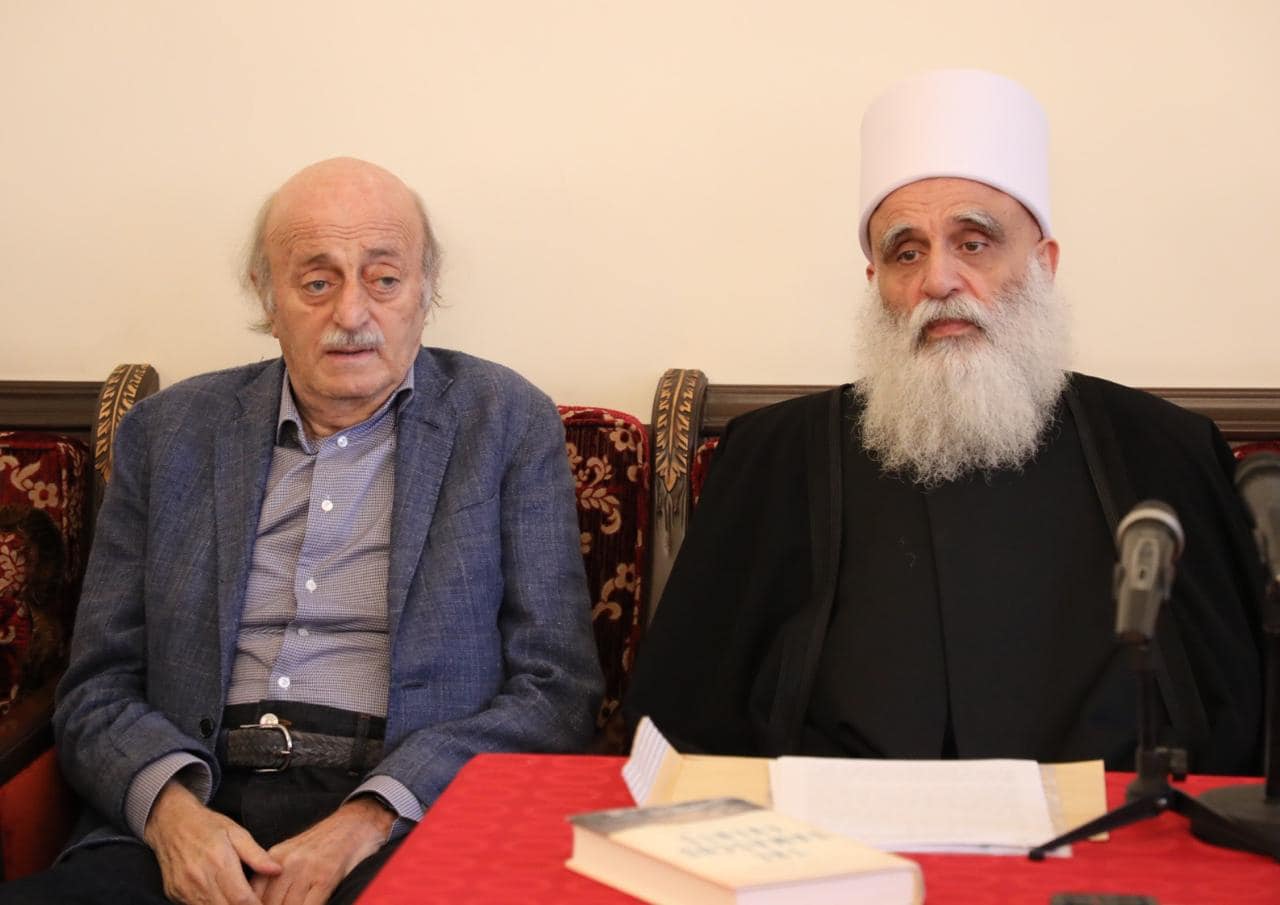
Sheikh Al-Aql
His Eminence Sheikh Al-Aql opened the session with a speech, saying:
In the name of God, the Most Gracious, the Most Merciful. Praise be to God, Lord of the Worlds, for all that He has bestowed, granted, provided, and honored. We praise Him, Glory be to Him, for the capability He facilitated for us to complete the electoral process to choose the members of the new Madhhabi Council. We thank everyone who contributed, strived, and cooperated. The structure of the Council has been completed with the election of 67 out of 68 members, as the position for the third member from university professors remains vacant since only two from this category submitted their candidacy. Additionally, five new judges joined the Council's membership by virtue of their positions. The current total number of members has reached thirty-four (34) permanent members and sixty-seven (67) elected members, in addition to the Sheikh Al-Aql, making the total number of current council members one hundred and two (102).
On our behalf, on your behalf Walid Bey, and on behalf of the permanent members, both present and absent, we welcome the new honorable judges and all the elected members. We hope that this fourth session of the Council will be a space for cooperation and effective work, and a period for the cross-pollination of ideas and joining hands, not only to address outstanding problems and challenges, but to innovate long-awaited sustainable projects—whether in terms of development and investment in endowment properties, the institutionalization of Unitarian cultural centers and family care offices, the organization and support of the Druze diaspora, or monitoring the status of religious councils in villages. These social, cultural, and educational projects must not remain mere ideas and proposals; we must together transform them into tangible and impactful realities during the six years that constitute the lifespan of this Council.
The responsibilities, tasks, and authorities held by the Madhhabi Council of the Druze Unitarian community are worthy of fulfilling the duty toward our community and our people on various religious, cultural, social, expatriate, legal, administrative, financial, and endowment levels. It is entrusted with everything related to these areas and is responsible for fulfilling its role and carrying its duty, in addition to the national role it plays in preserving the rights of the community and ensuring its effectiveness, whether through the Council's presidency represented by the Sheikh Al-Aql, the Board of Directors, or the General Assembly as a whole.
As you know, the Council keeps pace with national developments, cares for the issues of the people and society, contributes to strengthening the national partnership, and adopts appropriate stances in permanent coordination with the political leadership, in integration with them, and with the presidencies and spiritual, political, and administrative references in the state. In addition to its role in contributing to the community's revival and caring for its children, it has a primary role in affirming the identity of the community and solidifying the pillars of its existence in the face of the challenges and storms hitting the region, which would almost uproot it if we were not aware and conscious of the dangers of aggressive schemes and policies. But our spiritual, traditional, and national roots are firm, thank God, and we will safeguard them together, just as we safeguard the homeland. We will not abandon our role in the Sheikh Al-Aql office or the Council; we are here to serve the community and the homeland, and to preserve our existence, role, and mission.
While we congratulate the new members who volunteered to work with us by their own will, conviction, and enthusiasm, and with the knowledge, energy, and sincerity they possess, we hope they will be elements of goodness, faith, and vitality to activate the Council's work and improve its performance in accordance with its powers stipulated in Article Eight of the Law. We thank the previous members renewing their service in this Council, as they possess the experience, competence, and constant readiness for sacrifice. We also thank those who made space for others to engage in this experience, and our thanks also go to everyone who tried but was not lucky enough to enter this arena, hoping for cooperation with all to achieve the goals and develop the work.
We are pleased to hold the first session of the new Council today within the ten-day period following the issuance of the election results, according to Article 23 of the Law, drawing attention to a number of points we hope will be taken into account:
– The necessity for all members to review the Basic Law of the Council, the Internal Regulations, and relevant bylaws, with the possibility of working to amend and develop those regulations if your Council deems it necessary. As for any amendment to the Basic Law, it is related to Parliament, and there is no doubt that there are some observations that can be discussed later at the appropriate time if agreed upon.
– Emphasizing the importance of attending meetings, ensuring a quorum, and participating in and enriching discussions, noting that an elected member who is absent from three consecutive sessions without a valid excuse is considered to have automatically resigned, and no replacement shall be elected unless two-thirds of the members in their respective category become vacant.
– Confirming that committee meetings shall be held at the headquarters according to a fixed calendar and an agreed-upon mechanism, based on invitations issued by the head and rapporteur of each committee.
Honorable members,
You are today at the forefront, in the lead, and in the field of interaction and work. How many congratulations you will receive, how many sound opinions you will hear, how many sharp tongues will try to undermine you, and how many random criticisms you will face. Let us, and you, be up to the responsibility and endurance. Let us take sound opinions into account, handle constructive or malicious criticism with steadiness, positivity, and insistence on work, and let us initiate correction if duty, logic, and reality require it...
In the previous Council, we launched several initiatives that circumstances and resources did not allow most of them to be achieved—due to the health, financial, and security conditions that have governed the country since 2018 until today, and the transition of the Council's presidency from hand to hand. However, those that were achieved are worthy of follow-up: from organizing the endowment portfolio and restoring the Ma'ni School and its new launch, to social support programs, especially the "Sanad" program, the healthcare center in Aley, the Prince Al-Sayyid College for Unitarian Sciences in Abey, the Unitarian cultural centers that we have begun to expand, the qualifying training courses under the title "Mountain Pioneers," the experience of holding the Beirut exhibition for rural products, the honorary expatriate gathering, and qualitative cultural activities. All of these need follow-up, development, and sustainability, and that is the task of the current Council to ensure continuity and to invent what is new and possible.
Committee Chairs
After that, an oversight committee for the election of the Secretary-General, Treasurer, and committee chairs was formed, including Judge Abu Ghida and Sheikh Daniel Saeed. The results were as follows: Lawyer Raed Al-Najjar as Secretary-General, financial expert Hossam Hamza as Treasurer, and the committee chairs: Religious: Sheikh Ismat Al-Jardi, Cultural: Sheikh Wissam Suliqa, Administrative: Dr. Mansour Ashtai, Financial: Dr. Imad Al-Ghosaini, Endowments: Lawyer Hamadeh Hamadeh, Social: Lawyer Ghada Jumblatt, Legal: Dr. Talal Jaber, Expatriate Affairs: Mr. Jamal Al-Jawhari.
Committee Members
Then, the elections for committee membership took place under the supervision of a committee consisting of Secretary-General Al-Najjar and Judges Saeed and Manih Nasrallah. The results were as follows:
Religious: Sheikhs Khalid Safi, Samir Hamadeh, Nidal Sari Al-Din, and Moeen Al-Akkar.
Cultural: Numan Al-Sahili, Ghazi Mahmoud, Ferial Zahreddine, and Firas Zaidan.
Administrative: Firas Abu Diab, Zaher Al-Aawar, Ayman Zahreddine, and Amer Sayagha.
Financial: Issam Haidar, Hassan Salha, Hikmat Noufal, and Osama Dhubian.
Endowments: Sheikh Shaheen Hani, Sheikh Salman Al-Maghrabi, Sheikh Maqsad Abu Assaf, Riad Atallah, Jihad Shia, Tawfiq Al-Muhtar, Nader Fakhr, and Marwan Shrouf.
Social: Sheikh Farid Abu Ibrahim, Sheikh Salim Ghannam, Muhib Abu Zour, Salim Abu Ismail, Nasser Al-Masri, Jamil Talhouk, Rana Abu Shaqra, and Anwar Allama.
Legal: Salim Saeed and Maher Al-Ahmadiyah.
Expatriate Affairs: Ayoub Al-Jardi, Ghassan Rafeh, Tariq Dhubian, and Ihab Sarhal.