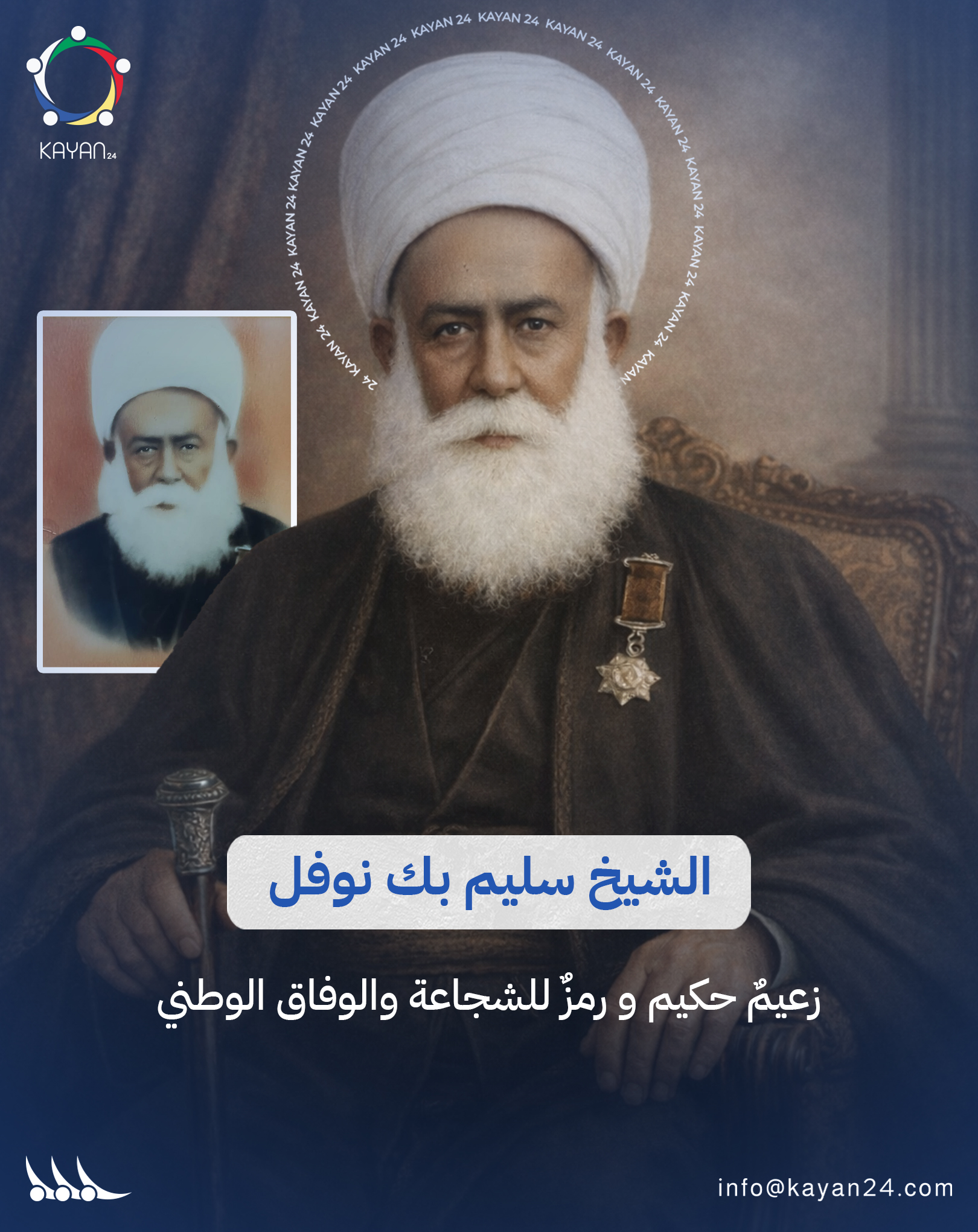

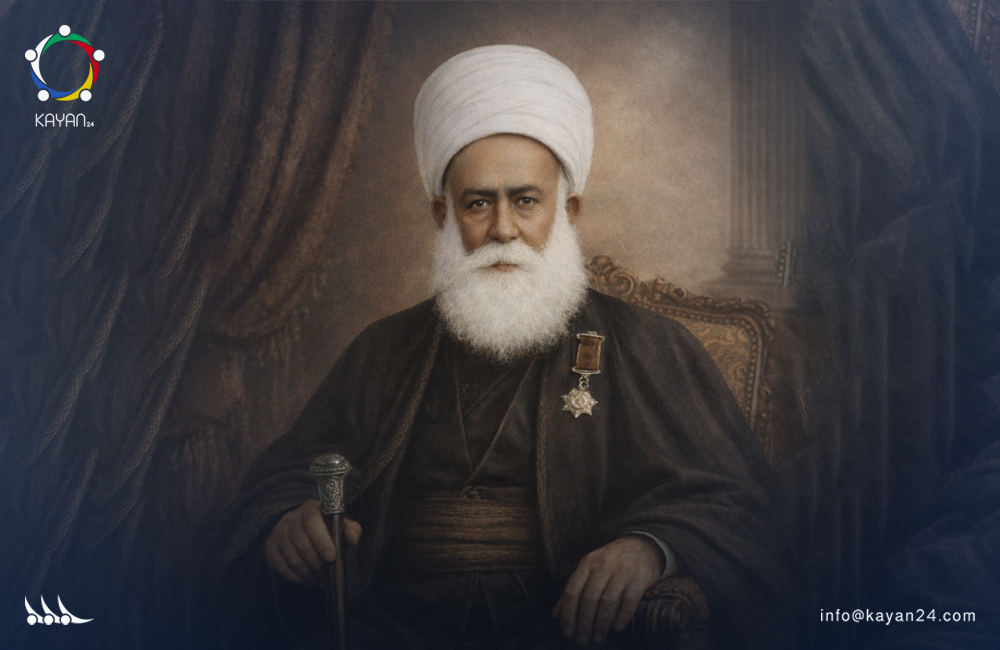
One of the Druze notables, (Salim Bey Nofal)
Born in the village of Al-Kfeir, one of the villages of the Hasbaya district; he inherited his leadership from his father, Hamad Bey Nofal. The origins of this family trace back to the Upper Mountain, meaning Jabal al-Summaq in the Aleppo region. Its men were known for their courage, as the guarding of the city was entrusted to them …
Amer and his cousin Nofal, along with their children and relatives, displaced from there. They settled in Qatana, and from there they went to Deir Hina in Mount Hermon. It happened that some neighbors harassed their women, so they attacked them in the mosque, and it is said that they killed 62 people. The Ottoman state arrested Yahya and demolished the building where Amer and Nofal were, killing them and everyone with them. Then, Yahya was executed by hanging in Damascus. As for Hamoud bin Amer, he fled with the son of Nofal and a group of their men to Umm al-Zaytun in Jabal al-Druze (Jabal Hauran) in the year 1805 …
A group from Nofal's descendants fled to Al-Rahibah in the Eastern Qalamun and embraced the Sunni faith; they are still known as the Nofal family. Others fled to Serghaya and also embraced the Sunni faith, and they are still known as the Al-Shamat family. Ali Nofal fled to the village of Al-Kfeir in the Hasbaya district, and his descendants are still there; they have achieved wealth, prestige, and influence, and have produced some of the best men for the world, including the famous Hamad Nofal and Muhammad Nofal.
He dedicated his life to serving the community around him with love, sincerity, and honesty. He had strong interactions with Ottoman state officials in the late 19th and early 20th centuries, as the Ottomans considered him a fundamental pillar for mediation between them and the people in the region, because he was a person accepted by both sides during a period when the prestige of the state, which had leaned toward tyranny, had weakened.
He was elected as a member of the Hasbaya district administration and as a representative for the Druze of Southern Lebanon in Damascus, and he earned several high-ranking Ottoman medals in appreciation of his social role at that time.
When the Great Syrian Revolt of 1925–1927 took place under the leadership of Sultan Pasha al-Atrash, and the revolutionary factions spread to Lebanon, with the people of the Wadi al-Taym region (i.e., Rashaya and Hasbaya) participating in it, Dr. Hassan Amin Al-Bu'ayni says in his book, "Sultan Pasha al-Atrash and the Great Syrian Revolt": A French force headed to Hasbaya, which had rebelled against the French, led by General Clément-Grandcourt. The revolutionaries attacked that force, killed 46 soldiers, and seized 21 mules, 16 rifles, and two machine guns. The people of Hasbaya were determined to fight, and a fierce battle broke out at Tel al-Awja, located west of Hasbaya. The outcome of the battles was 38 martyrs, including Sheikh Saleh Okasha and Sheikh Fares Abu Ammar, from the sheikhs of Khalwat al-Bayada. The French bombarded Hasbaya with artillery and aircraft, and after hand-to-hand combat, they demolished Khalwat al-Bayada and entered Hasbaya on December 5, 1925. They committed a massacre with loyalist agents, killing 12 of its peaceful residents who had not left it.
Here, the position of Sheikh Salim Bey Nofal emerged, as expressed by Dr. Muhammad Khalil al-Basha in his book "Dictionary of Druze Notables," where he says: "Salim Bey was able, with his wisdom, to spare the region (around Hasbaya) from being burned by the fire of the revolution, without offending the spirit of the revolution and its impetus. He protected the Christians in Al-Kfeir and its surroundings and pushed for reconciliation, unity, and harmony. The French appreciated this noble position of his, and a picture of him with the French High Commissioner, Count de Jouvenel, became famous.
He passed away in November 1927 and was buried in his birthplace, the village of Al-Kfeir.