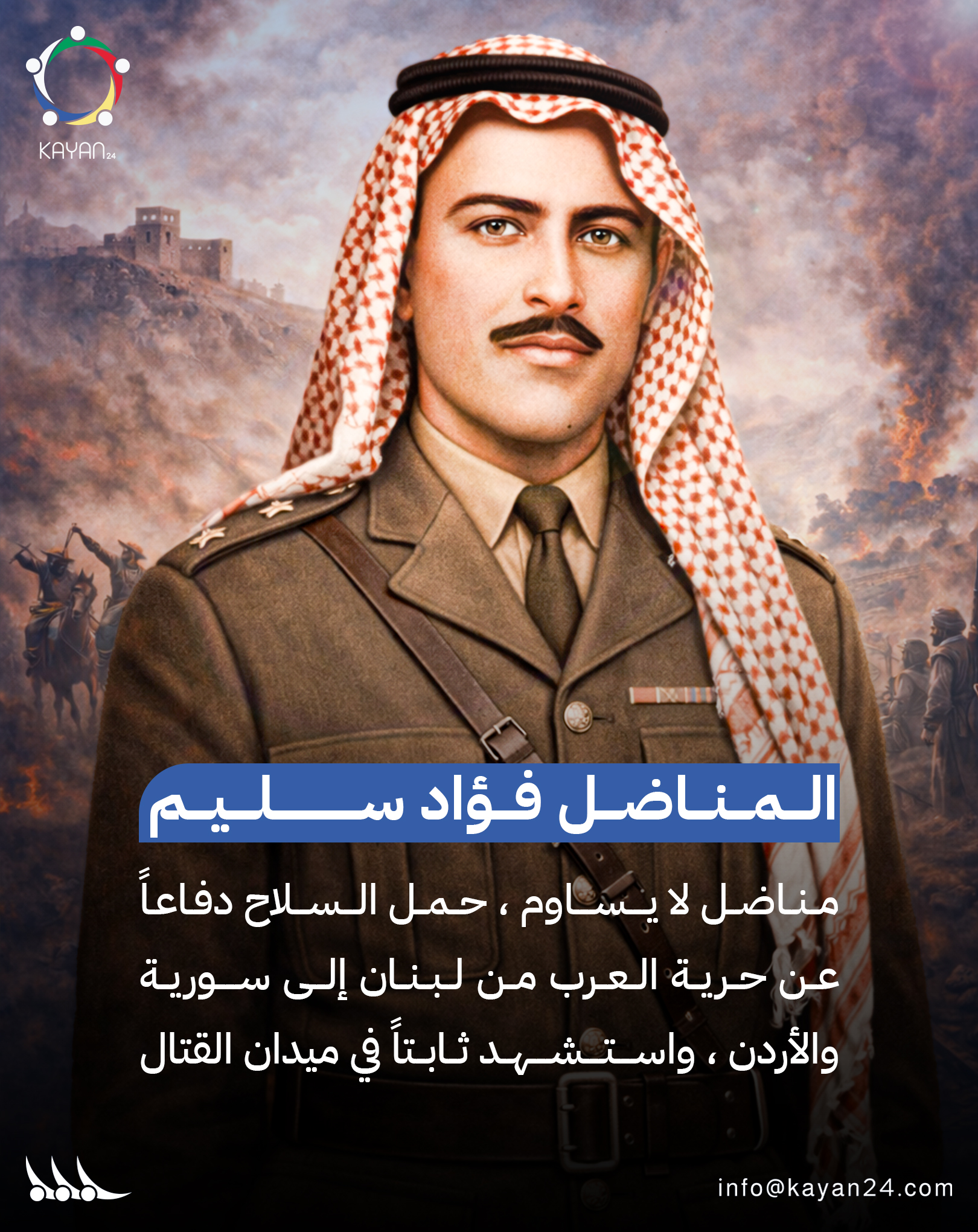

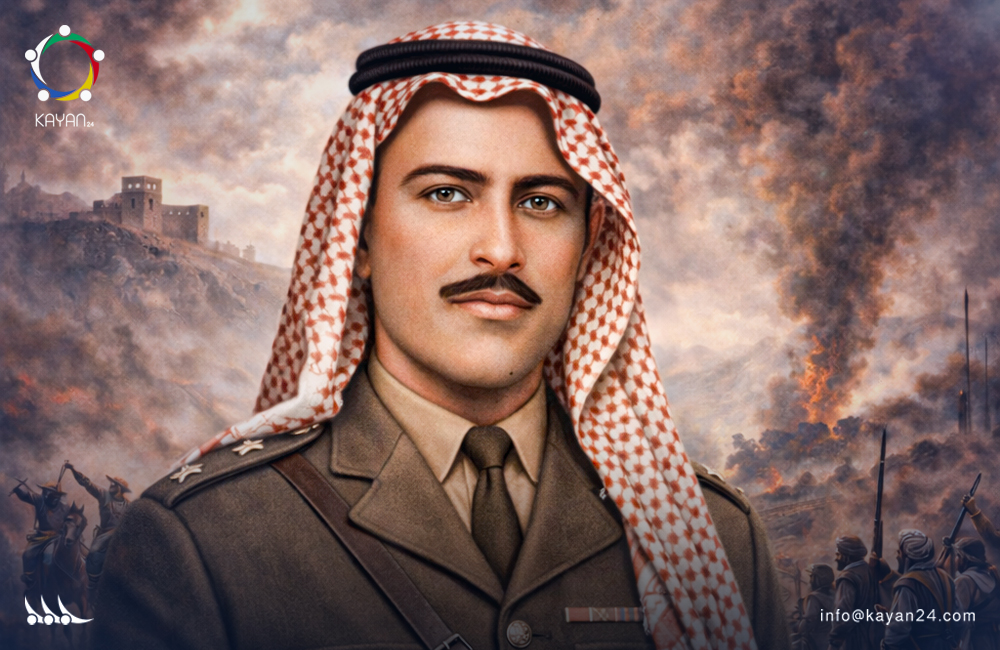
Fouad Salim was a leader and freedom fighter who courageously confronted the Mandate…
A glimpse into his exceptional personality reveals a man who was strongly present on the stage of military and liberation events throughout the course of his life…
Born in Chouf, Lebanon, in 1893, his father was the official physician of the Chouf District. He received his education at the American University of Beirut, where he mastered the English language, and then studied at the Ottoman College of Sheikh Abbas Al-Azhari in Beirut, where he became a teacher, later teaching in Baskinta.
Following the outbreak of the Arab Revolt against the Ottoman Turks, he joined it in 1917 and was promoted to the rank of second lieutenant;
He was assigned to the divisions led by Prince Shakir bin Zaid Al-Hashimi, becoming his right-hand man. He was tasked with attacking the Ottoman forces stationed along the railway line between Ma’an and Amman to disrupt military supply lines, demonstrating outstanding heroism.
Afterwards, he moved with King Faisal to Damascus, becoming one of his close confidants, where he was promoted to the rank of captain and assumed command of a regiment consisting of cavalry and infantry.
He also took part in the Battle of Maysalun, after which he moved to Lebanon to lead patriotic guerrilla bands against the French occupation, whose operations extended from Jabal Amel in southern Lebanon to the Alawite Mountains in northern Syria.
Among his heroic men who rose to prominence were Hamad Saab, Hassib Dhibyan, Salman Dhibyan, Saeed Melhem Bashir, Najib Hamada, Kamel Hamada, Hamad Al-Hasaniyya, and Salman Al-Hasaniyya. The French sentenced him to death in absentia, so he secretly moved to the Mountain and then to Jordan with the help of his relatives in the village of Al-Mujaymir,
with the goal of assisting Prince Abdullah in preparing for a comprehensive revolution in Jordan and Syria against the French, with Amman as its center. However, Abdullah began secretly cooperating with the British, behind the backs of his aides Rashid Tali’ and Adel Arslan and their comrades from the Arab Independence Party…
In Jordan, he was appointed commander of the cavalry battalion and later chief of staff of the army, successfully suppressing the Kulaib Al-Shuraydah revolt and the Adwan revolt, which had been instigated by the British to undermine the prestige of Prince Abdullah’s rule. Fouad’s success in doing so dealt a blow to British policy; consequently, an order was issued appointing him as an aide-de-camp to Prince Abdullah and removing him from the army after granting him the rank of Miralai (Colonel). He was then dismissed from the army along with his nationalist comrades and served with an order of banishment from the country. The British were directing this game against the Arab Independence Party that had emerged in the Levant following the expulsion of the Ottomans in 1918; however, he refused to comply with the banishment.
At that point, the British surrounded the palace with troops, forcing him to travel to Egypt, where he began publishing articles attacking both the French and British authorities.
The British pressured him in Egypt to cease attacking them, but he proudly and resolutely rejected their tempting offers.
Coincidentally, he was invited to the Hejaz to organize the Saudi army. While preparing for his journey, the Great Syrian Revolt broke out under the leadership of Sultan Pasha al-Atrash in 1925. He traveled secretly on camelback across Sinai toward Syria via Palestine, crossing the Jordan River, and met clandestinely with Druze figures in Prince Abdullah’s state, namely Rashid Tali’ and Ajaj Nuwayhid, successfully transporting quantities of weapons and medicine to the Mountain.
There, he joined the revolution and became one of its heroes, taking command of combat operations under the leadership of Zaid al-Atrash in the Ballan region, where Rashaya, Hasbaya, and their surrounding areas were liberated. Fearing that the revolt would spread into Lebanon, the French authorities mobilized their armies against the rebels from three directions: Damascus, Beirut, and Sidon.
During the fierce fighting in the Battle of Majdal Shams near Sjayna, the rebels felt that the forces were mismatched and decided to withdraw. Commander Fouad Salim remained with fourteen fighters to engage the army, thereby securing an opportunity for the rebels and residents of neighboring villages to retreat safely. After successfully achieving this, and as they were withdrawing, artillery shells fell upon them; shrapnel struck Commander Fouad Salim, inflicting several fatal wounds. This occurred on Saturday, 5/12/1925. He was buried there at Tell al-Aswad near the village of Sjayna, and that hill was subsequently named Tell Fouad. Omar Agha Shamdin built an exquisite marble shrine for him, inscribed with an overview of his life.
His fellow fighters attended his burial, headed by Zaid al-Atrash.
When the news of his death reached General Commander Sultan Pasha al-Atrash, he said: “Fouad has died, the spirit of the revolution has died, and our hopes for the revolution have gone with him.”