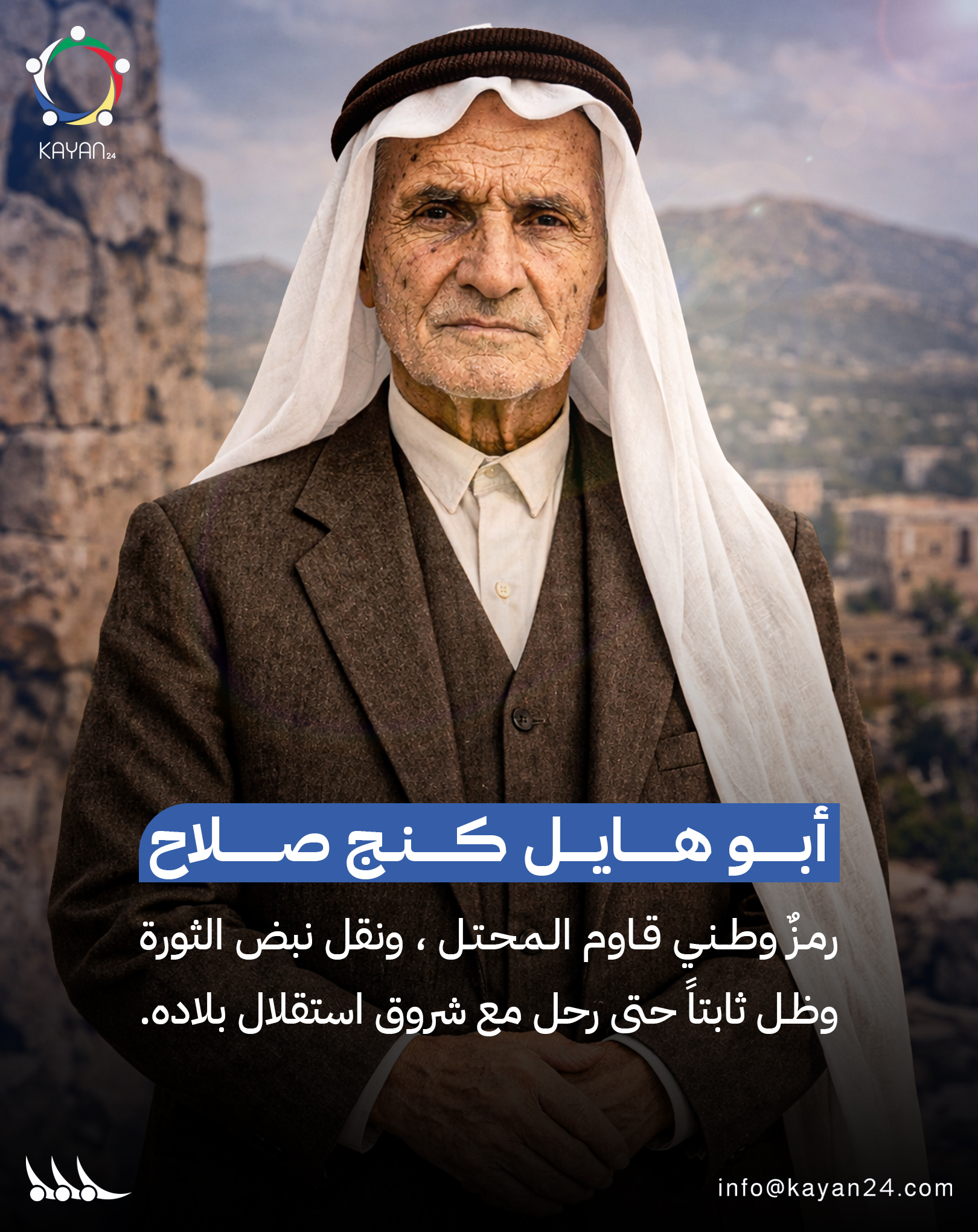

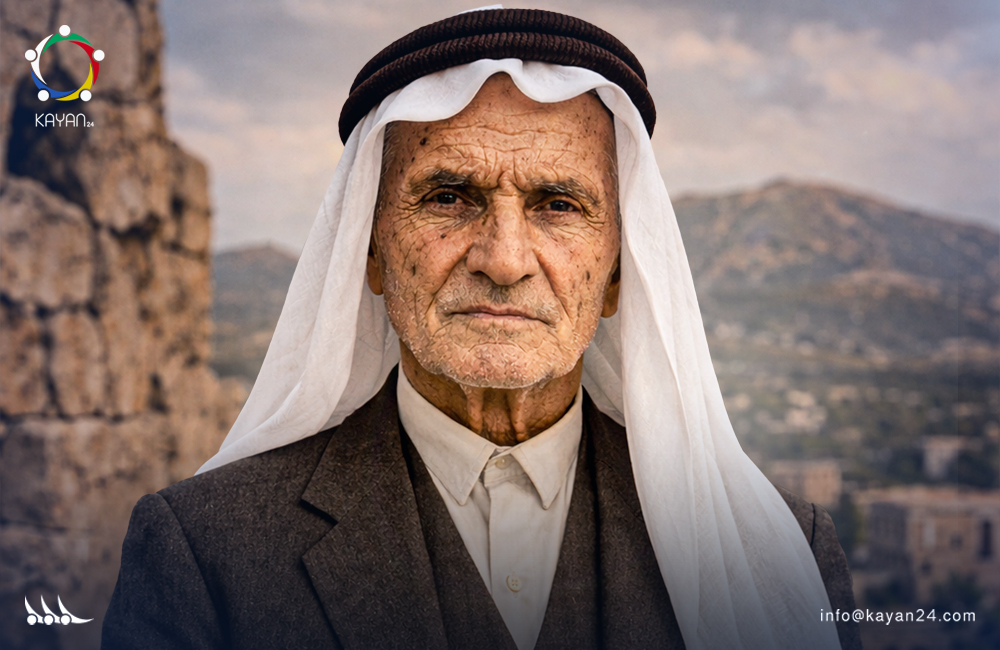
Abu Hayel Kanj Salah was the man whose confinement the occupier’s walls failed to achieve; he became the ‘lung’ through which the revolution breathed, and the courier who traversed distances to forge victory, until destiny chose him to pass away on Evacuation Day, as if refusing to depart this world until his homeland was left behind free and proud.”
He was born in the town of Shaqqa in 1890 and grew up in a local environment characterized by national activism and resistance to foreign influence.
He engaged in field action at an early age, participating in confronting Sami Pasha al-Faruqi's campaign at the Tell Muf'alani site.
He joined the ranks of the Great Arab Revolt and was among its most prominent activists, earning the trust of Sharif Hussein and Prince Faisal; he was presented with an Arab sword in honor of his military role and his efforts in service of the revolution.
He participated with the mountain cavalry in the Battle of Taloul al-Mani', the capture of Rida al-Rikabi, and the raising of the Arab flag over the government house in 1918.
He was at the forefront of participants in the Battle of Maysalun, fighting alongside the martyr Yusuf al-'Azma.
A death sentence was issued against him by the French military court, and he was imprisoned for a lengthy period, from which he managed to escape in a unique operation.
The Commander-in-Chief tasked him with the responsibility of securing communications and transporting sensitive military documents to the clans and the people of Ghouta. Owing to his speed and precision in executing missions under French surveillance, he earned the title of “the revolution’s express courier”.
He played a pivotal role in coordinating field operations and expanding the reach of the revolution to encompass the regions of Qalamoun, al-Nabek, and Western Ghouta, which contributed to dispersing French forces.
He contributed to organizing and convening the revolution's conferences in 1926 in the towns of Shaqqa, Busan, Muf'aleh, and al-Hawa. In 1927, he sustained severe injuries as a result of French aerial bombardment in the al-Safa region.
He accompanied the Commander-in-Chief Sultan Pasha al-Atrash on his journey into exile to al-Azraq and Wadi al-Sirhan, later returning to Syria while continuing his patriotic path until independence was achieved.
After being reassured that the message had been delivered and the land had been liberated, Kanj Salah laid down his weapon and rested, leaving behind a legacy that absence cannot erase, and a body that returned to its Creator on the very day Syria embraced the dawn of its freedom.