
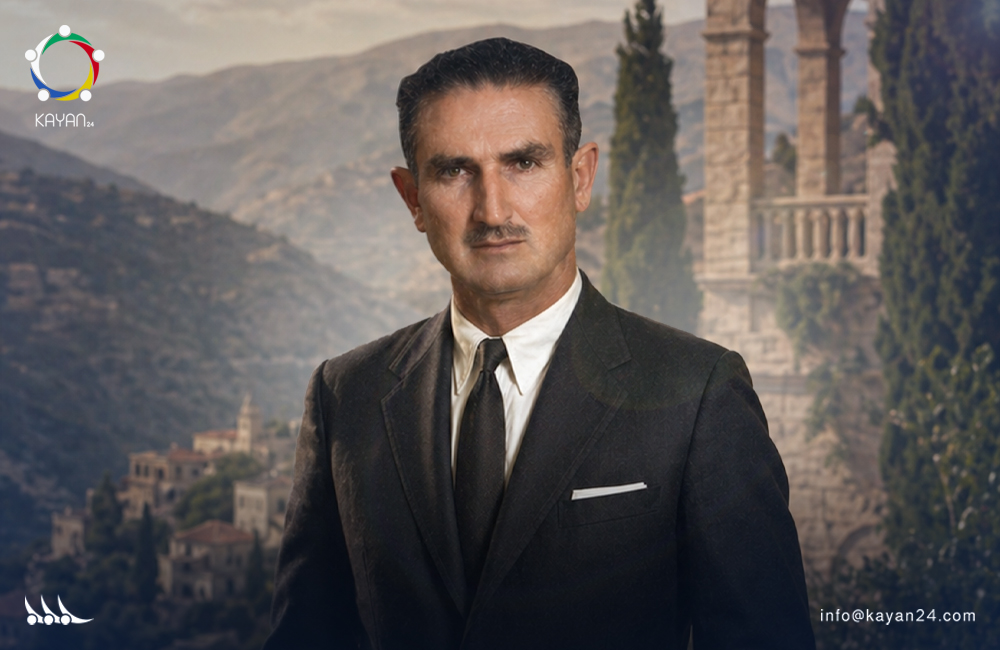
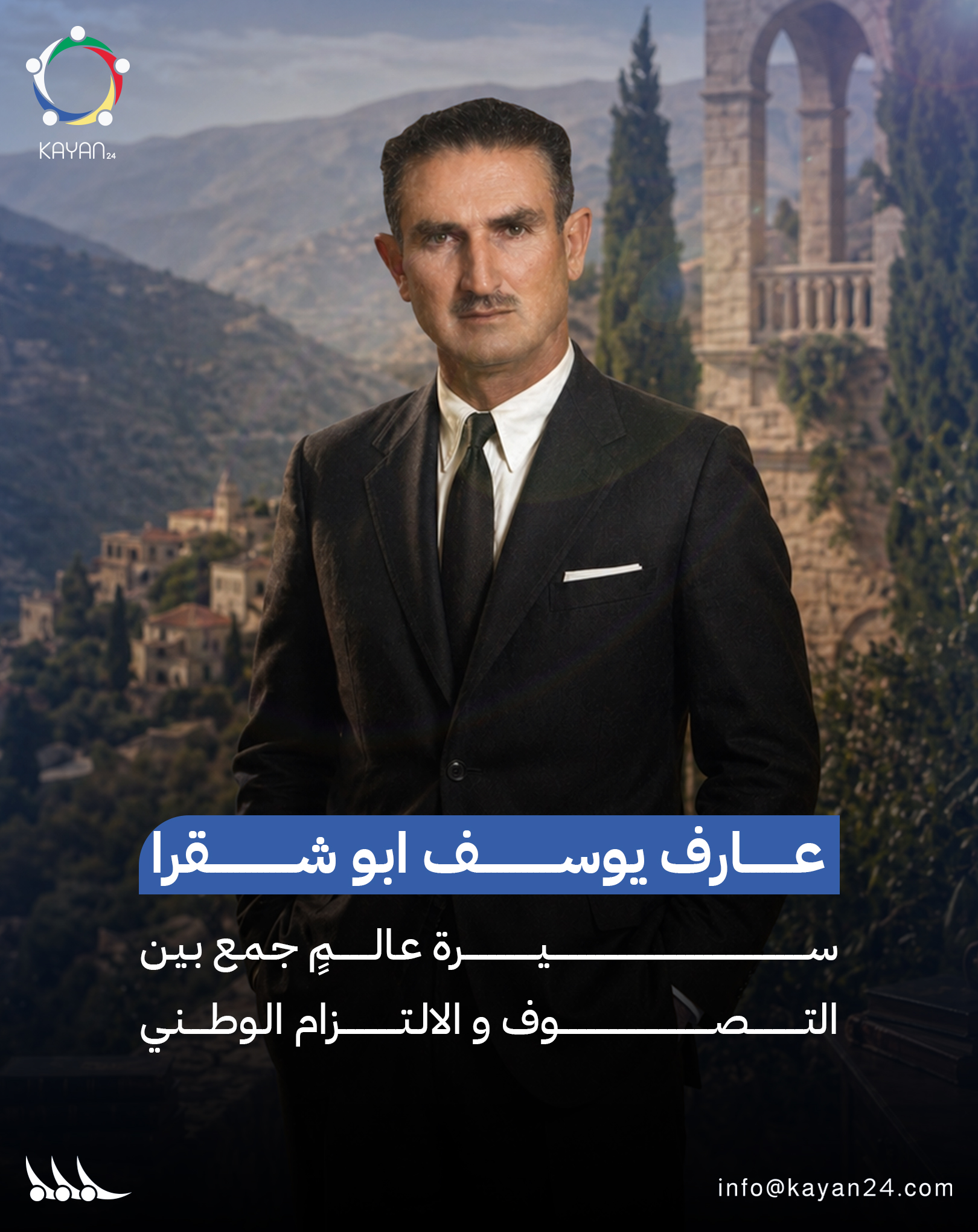
In the presence of thought and literature, we recall a towering scholarly figure from Mount Lebanon, a writer, poet, and historian who forged history with his intellect and established a methodology of asceticism and monotheism with his pen. He is the great master #Aref_Yousef_Abu_Shaqra, who was not merely a writer, but a man of profound vision that combined the rigor of language, the depth of Sufism, and the strength of a national stance.
The great master Aref Yousef Abu Shaqra
He was a poet, writer, orator, and held sound views on Islamic Sufism...
He was born in #Amatour_Al-Shouf, the stronghold of the Abu Shaqra and Abdel Samad families.
His father died in 1903, so he was raised by his grandfather, Khattar. He received his primary education in Amatour, then at the school of Mu'allim Touma in Al-Mukhtara, and then at the National School in Choueifat, graduating in 1914. With the outbreak of World War I, he was unable to enter university, instead devoting himself to deep study of the Arabic language and its literature. When the war ended, he established the Amatour School with Amin Effendi Abdel Samad. A few years later, he moved to the school established by Shafiq Bey Al-Halabi in Ain Qani, Shouf, where he taught first, and then took over its administration. In 1928 and 1929, he participated in editing "Al-Amali" magazine for Dr. Omar Farroukh. From 1939 to 1941, he continued writing for several newspapers, most notably "Al-Anbaa," often signing under the pseudonym (Abu Dhar). In 1956, he left the Islamic Maqasid after teaching there for 28 years and went to teach at the Saudi College in Burj Al-Barajneh. During those activities, he edited and verified the book "Movements in Lebanon" and published it. He also wrote a book titled "Three Scholars from the Sheikhs of Bani Ma'ruf," along with a large number of poems, articles, and research papers on various topics. He has unpublished manuscripts, including "Ethics of the Druze Religion (Madhab)", "History of Mount Druze," and a poetry divan, most of the poems in which are unpublished.
In his book "Three Scholars from the Sheikhs of Bani Ma'ruf," he covers the biographies of three sect sheikhs: Sheikh Emir Saif al-Din al-Tanoukhi, Sheikh Yousef al-Kafraqouqi, and the virtuous Sheikh Muhammad Abu Hilal.
In the introduction to that book, he graces us with his vision of the Sufism of the Druze monotheists, stating: "Sufism, in all stages of its development—whether Indian, Chinese, Christian, or Islamic—is based on asceticism in the world, influenced by creeds, philosophies, inclinations of souls, and thoughts of the mind, such that it is impossible to form from this a clear Sufi plan or a recognized method that everyone who follows the path of Sufism and adopts it as a way of life should follow."
"We know that the Proof of Islam, Imam Abu Hamid al-Ghazali, who dedicated himself and his knowledge to serving the religion to preserve faith for the common people, witnessed Jerusalem fall into the hands of the Crusader Franks and lived for twelve years after that without mentioning this great (dangerous) incident. If he had called upon the people of Iraq, Persia, and the lands of the Turks to support their brothers in the Levant, hundreds of thousands would have set out to fight in the cause of God, and they would have spared the Arabs and Islam eras filled with struggle and centuries teeming with ignorance and destruction. Al-Ghazali's neglect of this was only because he had by then turned into a Sufi or was at least convinced that Sufism was one of the paths of life, or rather the straightest and happiest of those paths."
"Sufis do not lack justifications for what they do; they believe that there are sinners among their people, that calamities befall them as punishment, that this is done by the will of God Almighty, and there is no repelling what God has willed, and there is no need to complain about it."
"European colonialism exploited this negative phenomenon in Islam, and there are incidents in the Levant, Egypt, and the Maghreb that attest to that..."
"But we do not find this phenomenon among the Bani Ma'ruf. To our knowledge, groups of Bani Ma'ruf, most of them wearers of the turban, marched under the banner of Saladin in the fight against the Franks, just as they marched under the banners of their princes from the Tanoukh and Ma'an families in those very same wars..."
Aref Abu Shaqra presented a unique model of the working scholar who combined asceticism with national responsibility. His Sufism was pure of impurities, and his patriotism was firmly established. He departed, leaving behind an intellectual legacy that proves that wisdom does not mean withdrawal, but rather effective presence in the heart of the nation's battles and the preservation of its authentic heritage.