
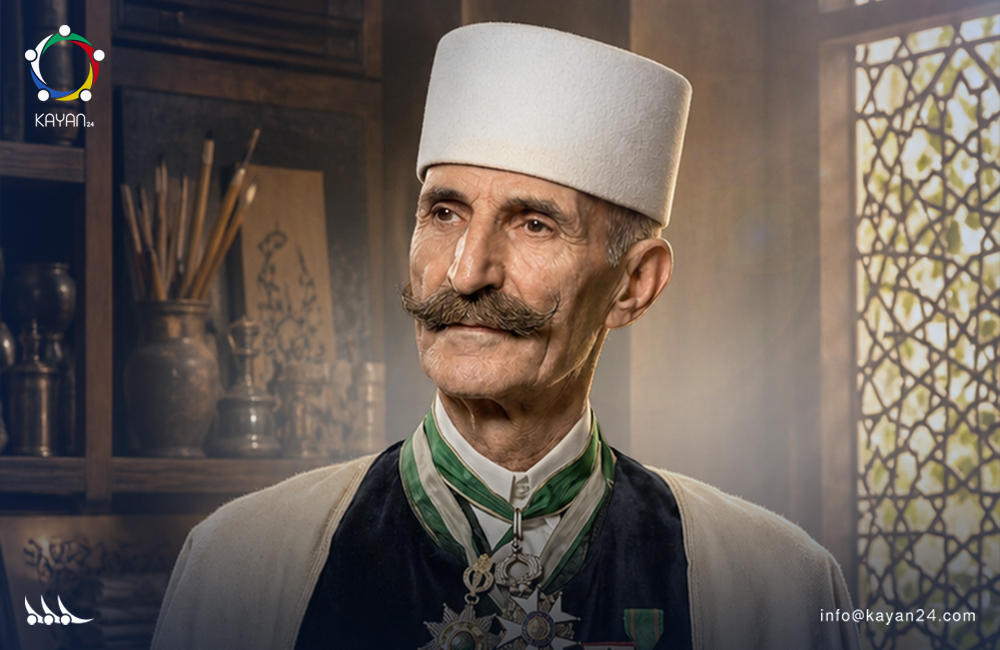
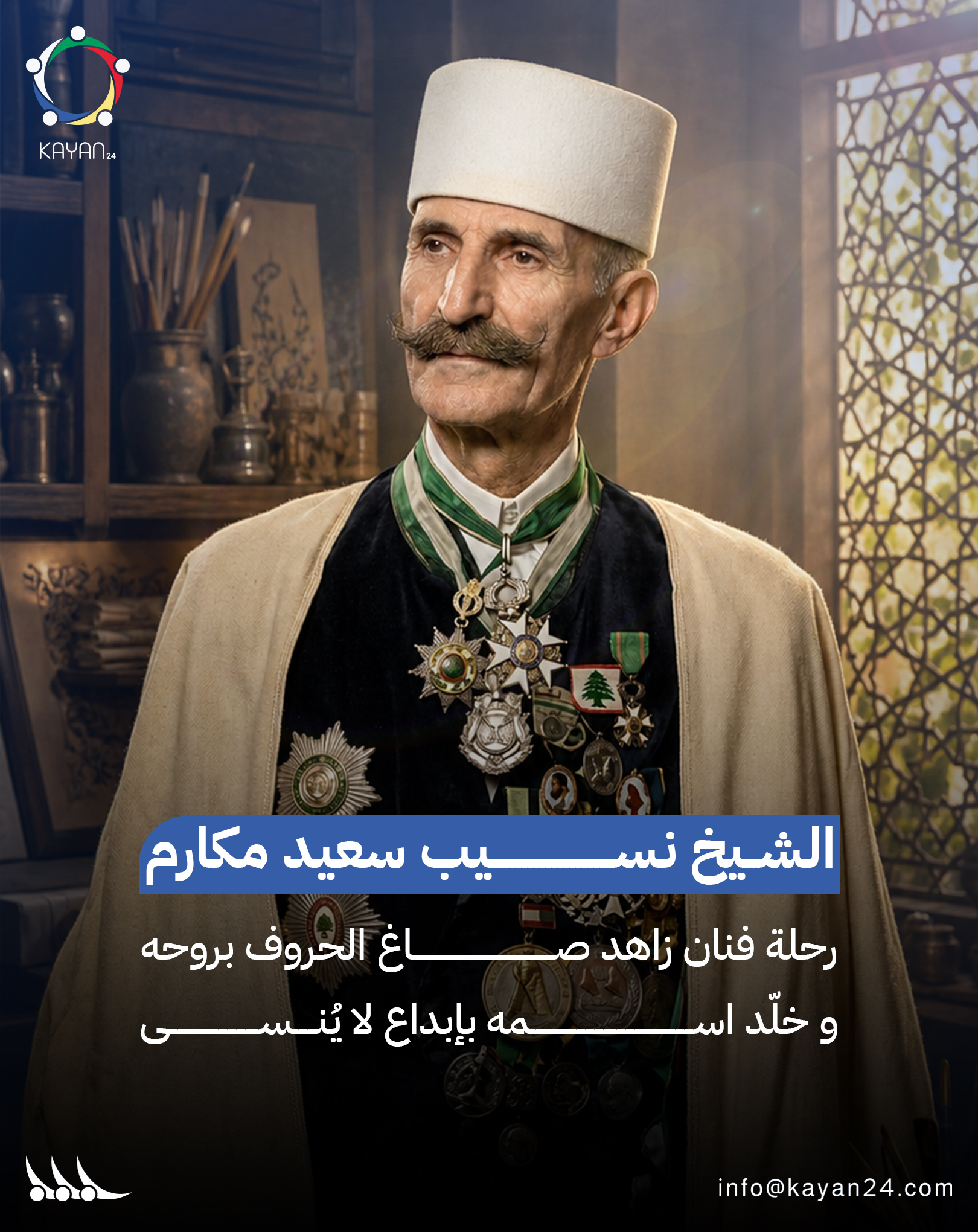
In the history of Arab art, figures occasionally appear who do not resemble their own time, but rather create a time of their own. Men who write the letter as if writing a prayer, and treat beauty as if it were an act of worship. Among them stands Sheikh #Nassib_Said_Makarem, who transformed Arabic calligraphy into a space of wonder and made silence a companion to a life full of giving. This is the biography of a man who lived for art and left an indelible mark.
Sheikh Nassib Said Makarem was born on September 14, 1889, in the village of Aitat, and grew up in a home that combined piety, hard work, and artistic taste. He joined the American School in Souk El Gharb in 1903, but the death of his father four years later forced him to leave school and work to support his mother and eight siblings. He learned the trade of carpentry from his father, while his love for Arabic calligraphy was inherited from his mother, Athba, a 1886 graduate of the Shamloun English School and one of the first Druze women to earn a high school diploma in the nineteenth century. His mother had beautiful handwriting and encouraged her son to master this art, so he combined carpentry by day and calligraphy by night, placing his fingers in the service of beauty in both works.
In 1909, Nassib read that Prince Izz al-Din Jawad al-Tanoukhi had written the Verse of the Throne (Ayat al-Kursi) on a grain of rice, containing about fifty words. This piqued his curiosity, and he decided to compete with him. He wrote a passage of sixty-one words on a grain of rice and displayed it at the Zahle exhibition, where he won the first-place prize. From that day on, his name became famous as an exceptional creator in the art of Arabic calligraphy.
In 1921, Sheikh Nassib established his first office in Martyrs' Square in Beirut, then moved to a second office in Souk Ayas, and then a third office on Rue du Parc (Exhibition Street), where he remained for forty-four years, writing and being consulted as an art expert by the courts. In addition to his work, he taught the art of Arabic calligraphy and engraving in numerous institutions: the Lycée Français, the American University of Beirut, the Islamic Sharia College, the Three Moons School, the Lebanese College in Souk El Gharb, and the National University in Aley.