
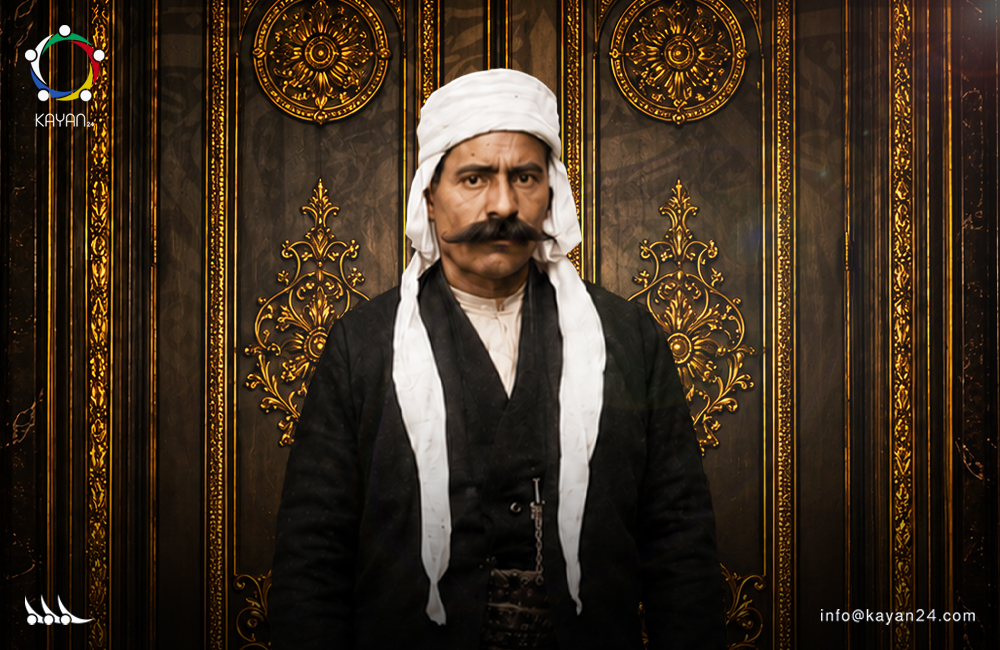
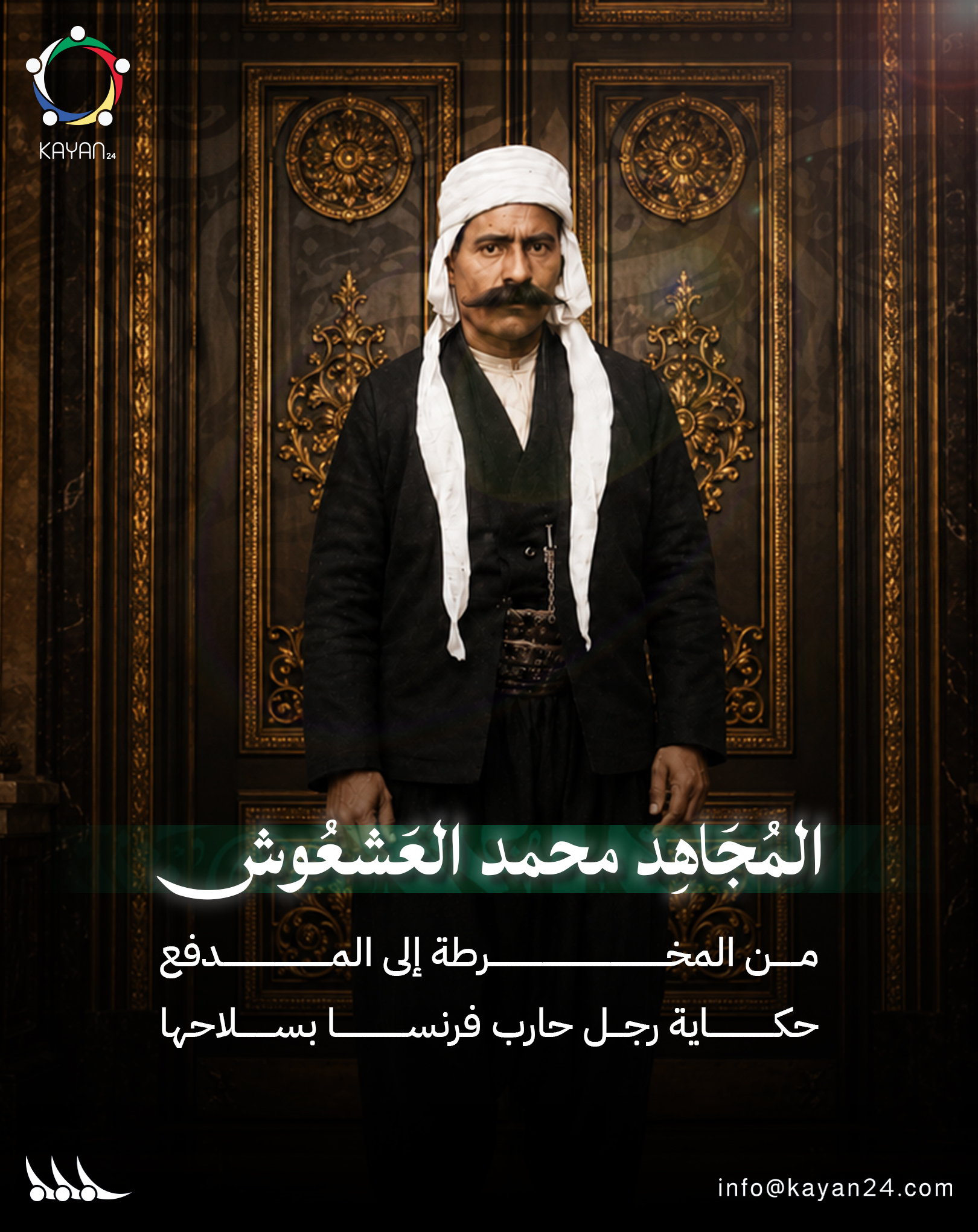
Muhammad al-Ash'oush, the artilleryman of the Great Syrian Revolt (1925–1927).
The al-Ash'oush family traces its origins to the Aql family in Baysour and Aley in Mount Lebanon. Their current surname comes from the fact that the family's earliest forefather suffered from "al-ashw" (nyctalopia, or night blindness)…
Muhammad bin Hussein al-Ash'oush was born in 1888. His father had emigrated from Aley after selling his property, taking his wealth, and heading to As-Suwayda, where he purchased agricultural lands and vineyards. He established water-powered mills, later upgrading his business to mills powered by coal and diesel. He relied heavily on his son Muhammad, who excelled in his trade and replaced German and English experts in receiving and installing imported mills across Syria, Lebanon, Palestine, and Jordan. Muhammad acquired a workshop and a lathe to manufacture many mill components without relying on the original manufacturers. He employed numerous workers and repaired individual firearms, such as rifles and pistols, earning the reputation among locals as a skilled gunsmith.
Following the Battle of al-Kafr and the overwhelming victory of the rebels, the French, along with their families and a number of collaborators, sought refuge in the Citadel of As-Suwayda. The rebels laid a tight siege around it…
At that point, the young Muhammad closed his workshop, took up his rifle, brought along one of his most skilled apprentices, and joined the rebels besieging the citadel.
He recounts in his memoirs that French aircraft would arrive laden with supplies to drop them into the center of the citadel to support the besieged forces. Despite flying at the lowest possible altitude, much of what was dropped fell outside the citadel walls,
falling into the hands of the rebels as spoils.
The Martyrdom of His Brother:
His brother Yousef was participating in the siege beside him, unarmed. When Yousef saw the muzzles of the besieged soldiers' rifles protruding from the embrasures close to the ground, he thought of seizing a rifle by snatching it from its holder. He coordinated with Suleiman Daoud Abu al-Fadl, who was also unarmed, agreeing that Suleiman would advance from the west by the water sluice, while Yousef would advance from the north from the direction of the Abu Asali plain. They put the plan into action: Yousef crawled on his stomach through dry brambles, bypassed the barbed wire surrounding the citadel, grabbed the rifle of one of the riflemen, and began pulling it with all his might. However, another soldier assisted the rifleman, and since Yousef was gripping the rifle from the muzzle end pointed directly at his abdomen, it was easy for them to shoot him. He was hit in the stomach. His brother Muhammad crawled through a dry stream bed, carried him on his back, and crawled back until they reached the dry wadi, away from the enemy's line of fire. He took him home and sutured his wounds with a packing needle and thread as best he could, but the wounded youth did not survive long and passed away.
The rebels continued their siege of the citadel…
An Attempt to Burn the Citadel:
Following the burial ceremonies, Muhammad returned to take part in the siege and avenge the death of
his brother. He had devised a plan to burn the citadel by spraying gasoline around its perimeter, though reaching its walls across open ground was perilous…
The idea entailed spraying gasoline around the citadel wall and preparing bottles rigged with explosives so that a number of them could be launched from short French carbines, of which the Druze had captured many. This would ignite the gasoline, causing the fire to spread both inside the citadel and outside where the gasoline had been sprayed…
The plan was put into effect: young Druze men from Lebanon, including members of the Abu Sa'da family and others, sprayed the gasoline, everyone working in a frantic race against time. Others threw bombs while some sprayed fuel, but the plan did not succeed as intended.
Distress calls echoed from inside the citadel pleading for rescue, while French aircraft bombed the city of As-Suwayda.
The rebels fired back at the planes, while Muhammad urged his comrades to drop flat on the ground during airstrikes instead of running left and right…
Muhammad al-Ash'oush: The Mind Behind Fighting the Enemy with Their Own Weapons:
The rebels had disabled an aircraft that crashed about 3 km away in the village of al-Aslihah, west of As-Suwayda.
Muhammad reached the wreckage and dismantled telephone equipment and other useful materials. He was unable to participate directly in the Battle of al-Mazraa due to his involvement in the siege of the citadel, but he went down to the battlefield afterward and witnessed its outcome. He recounts: The ground was covered with piles of corpses, and people were scrambling to salvage whatever they could of provisions, ammunition, cartridges, ramming rods, and powder paper. Horrified by the grim sight, he found no joy in what he saw, but before leaving, curiosity prompted him to collect what was relevant to his craft. He recalls:
I gathered the remaining jacks, artillery ramrods, and cannon bore brushes from the unexploded or disabled artillery pieces, and returned to inform the Pashas (the al-Atrash family) that we could fight France using the gear and weapons we had captured on the battlefield, and that we could drive them out if we knew how to manage it. I suggested storing those remnants in the house of Anis al-Muhaythawi, as he possessed a large residence in the old quarter of As-Suwayda and was deeply trusted, and placing a guard over it so that if France raided us again, we would fight them with their own weapons.
While I was pondering this, they were looking for me. Before reaching the guest house of the al-Atrash family, some men came rushing toward me, shouting at the top of their voices: Where are you, Abu Shahin… where are you…?
Sultan Pasha Honors Him:
The men said to me: The Pashas at the al-Atrash guest house have sent for you; you must come at once…
I arrived, and as I stood at the threshold of the guest house, Sultan Pasha addressed me: "Come, sit beside me here. They told me you are a knowledgeable man and a master craftsman, a man of brilliant intellect… and we want you to repair this large cannon for us so we can strike the citadel and demolish it. We have no one else but you, and everyone directed us to you, saying there is no one for this job except Muhammad al-Ash'oush, for he is more than capable."
I replied: "I am at your service, Pasha. As long as we draw breath, we will never hesitate or spare our blood for the homeland…"
He asked: "What do you need to bring the cannon from the battlefield at al-Mazraa?"
(Al-Mazraa was about 5 km from As-Suwayda).
I told him: "I need seven or eight strong men to accompany me so we can lift the cannon barrel onto a cart. I brought several heavy-duty jacks from the battlefield capable of lifting four or five quintals, with which I can lift the barrel onto the cart and have it drawn by mules to Khallet al-Nasrani (a site west of As-Suwayda that has now been overtaken by urban expansion and lies in its center). But I need men to support the cannon so it stays mounted on the cart without tipping to the right or left."
Sultan Pasha called out in his booming voice to those present: "Who will go with him?"
Twelve men were chosen for me, among them Ahmad al-Sha'ar.
When we arrived at the cannon and attempted to move it, we could not even flip it from one side to the other, as it was around five meters long; neither the men nor the jacks proved sufficient.
I returned to the Pasha and said: "The men were not enough, Pasha. We need seventy men, ropes, and padding to tie it down and haul it from place to place."
The next day, they assigned me seventy men. We turned the cannon and strapped it tightly with metal banding because its breech was damaged. Some men pushed while others pulled the cart alongside the mules, and this continued over a distance of more than 4 km until we reached Khallet al-Nasrani, about half a kilometer from As-Suwayda, near the house of Hasan al-Jarmani at Nazlat al-A'waj—a sheltered spot hidden from the citadel, which could have targeted us with its shells.
I set about repairing the cannon, machining screws for it on my lathe similar to mill screws. At first, the cannon did not function. Every time I needed to take measurements for screws, I had to carry the part from Khallet al-Nasrani to the lathe at our home and then return, all of which meant traveling by mule and wasting precious time.
Mahmoud al-Halabi, who lived next door to us, mentioned that his house had a spacious courtyard and an abundance of coal, suggesting we move the cannon to his residence to save time and effort. Indeed, the men hauled the cannon a distance of about 400 meters to Mahmoud al-Halabi's house, on what is today al-Sha'rani Street. We camouflaged the cannon with goat-hair rugs (used as tents by bedouins and traditional floor mats in settled households) so it would not be spotted from the citadel.
This placed me close to my home, where the forge, the coal furnace, and the lathe were located, and where men were around me to assist—some pumping the bellows and others helping me at the lathe—until I successfully repaired the cannon. I crafted an iron reinforcement strap and heavy bolts to brace it from all sides. We then moved it back to the tactical position at Khallet al-Nasrani, built an emplacement for it, reinforced the roof with rails taken from the railway line the French had laid to As-Suwayda, and covered the roof with soil for camouflage.
During our work on the cannon, the French fired artillery shells at us, but none hit our position.
We fired three test rounds at the French using their own cannon. The first shot struck the ground in front of the citadel. We raised the elevation of the barrel and fired a second shot, which landed behind the citadel on land east of it belonging to the village of Masad. We adjusted the aim to the center, and our shell struck the citadel wall. The sun was setting, so we ceased fire until the next day.
The following day, we fired several shells, all of which landed inside the citadel.
The residents of al-Musharraf neighborhood were watching our work. A man named Suleiman Amr, speaking in a Chouf accent, approached us and asked: "Do you know how many shells they've fired at you from the citadel?" We said no. He replied: "They've already fired 44 shells."
When the men around us heard this, they fled toward the northern gully nearby so no one would see them—more than two hundred men in all. Only Sa'id al-Hinnawi and I remained. I said to him: "Let's run and catch up with our folks." He answered:
"Keep your faith in God strong." His words fortified my courage with steadfast resolve.
The next day, Sa'id al-Hinnawi departed to the battlefields of the revolt, which required men of his caliber, reassured that our artillery post was secure. I remained alone at the cannon. Determined not to falter and to prove that I could decimate the French with my gun, I fired 38 shells at them. They struck between the windows and between the first and second floors, shattering walls, smashing glass, and crashing into the parapets and trenches in front of the citadel. Every time I fired a shell, I would stand up to observe the point of impact through binoculars, then reload the cannon with the next shell. However, my shells ran out; I found a crate full of percussion primers, but there were no shells or gunpowder left to charge them..
The next day, we rode to al-Muqran al-Shamali accompanied by Najib Abu Asali (brother of Shibli), Faris al-Bad'eesh, and a man I did not know. We were four horsemen searching al-Muqran al-Shamali for anyone who possessed primed casings salvaged from the defeated French army at the Battle of al-Mazraa, or unprimed casings so I could fit them with primers and fill them with powder. Those who had captured flat flakes of gunpowder (which resembled sheets of paper and which we ground down gently and without friction) had been burning them during the war, and their women were using them to bake bread.
During our tour of al-Muqran al-Shamali, we brought back gunpowder and casings. Upon our return, the leadership in As-Suwayda instructed us to move the cannon to the vineyard of Jabr al-Abbas at the northern al-Khurrayj site overlooking the citadel, unlike Khallet al-Nasrani and Nazlat al-A'waj. We constructed an emplacement for the cannon there, and I began packing gunpowder into the casings at my workshop after fitting them with primers, handling them with extreme caution so the powder would not ignite, especially since the French flake powder required delicate filing to prevent friction-induced combustion.
Bureaucracy Disrupts Our Work:
After moving the cannon to the northern al-Khurrayj, a misunderstanding arose with the crew assigned to work with me on the piece, including Moroccan and African defectors from the French army. The leadership considered them more experienced than me on the grounds that they had previously operated the cannon while serving with the French. Ali Bey al-Atrash supported their view in his capacity as overseer of our work on behalf of Abd al-Ghaffar Pasha. A heated argument ensued between them and me, and I resolved to step down from the cannon.
My assistant, Saleh Abu al-Fadl, was likewise angered by the interference in our work and left us to serve elsewhere with the rebels. I voiced my protest to Abd al-Ghaffar Pasha, but Ali Bey began shouting at the top of his voice: "Let them do their job and come with me to see where our shells are landing!"
I walked with him reluctantly.
At that very moment, the unthinkable and unimaginable occurred: an explosion erupted behind us at the cannon position. They told us that an incoming shell from the citadel had dropped straight down the barrel, blowing it apart, destroying its shelter, and scattering everything at the site. Two men were killed, and another was burned by the powder prepared for ammunition…
Shells rained down upon us wherever we turned, after which we withdrew to As-Suwayda with heavy hearts…
When Abd al-Ghaffar Pasha learned that I wept when the cannon was destroyed, he said: "He has every right to weep, for we cannot procure another cannon like that to bring down the citadel."
Afterward, Muhammad al-Ash'oush took part in the defense of As-Suwayda and carried a dispatch from the people of As-Suwayda to Sultan Pasha, who was with the rebels in al-Muqran al-Qibli. There, he met Muhammad Izz al-Halabi, who told him: "Give me the message; it is too dangerous for you to reach the Pasha because the French have put a bounty on his head." So he handed it to him.
He also fought in the Battle of Umm al-Rumman, where he dismantled three machine guns from four armored vehicles disabled by the rebels.
Muhammad al-Ash'oush was also among the rebels who impeded the advance of the French army marching to capture the Citadel of Salkhad, accompanied by As'ad Qardab from As-Suwayda. Afterward, they headed toward Arman, exhausted by hunger, only to find it deserted. They drank from its cistern and pressed northward, weak and starving.
At Tell al-Qaynah, they encountered Ismail Duway'ir, who hosted them for a meal and gave them rest. Muhammad then headed to the town of al-Mushannaf, where he reunited with his family, who had taken refuge there. From there, he proceeded to the village of al-Shabaki, where he found a group of rebels resisting the offensive of General Andrea, who was attempting to encircle the mountain from the north. Among them were Shakib Wahhab and Hasan Shuhayyib. He joined them on an urgent mission, confronting the French between Atil and Salim, after which they returned to fight the French across the villages of al-Muqran al-Sharqi.
He subsequently settled with his family in al-Mushannaf, where his father's mill was located.
While traveling to Qanawat to procure coal for the mill, he was arrested by a French patrol and handed over to As-Suwayda. When the French discovered he possessed machining and industrial expertise (lathe operation), they released him from prison and employed him in public works maintaining the water supply lines.
When the French captain later learned of his role in the revolt—how he had mined a railway track and blown up a French train—he told him: "You deserve to be beheaded."
Muhammad replied: "We fought you with your own weapons. You bombarded our villages with cannons and airplanes. You could have taken my head on the battlefield, but now I am in your custody, and this is a time of peace."
The officer's tone instantly changed; he patted him on the shoulder and said: "Bravo, Ash'oush! Very well, very well!" and walked away…
On the day of his memorial service on September 25, 1982, the nationalist Arab lawyer Tawfiq Ubayd eulogized him, saying: "Today we bid farewell to the freedom fighter Muhammad al-Ash'oush as one bids farewell to the commander and chief engineer of artillery in the Great Syrian Revolt…"
Ibrahim al-Aqel, Studies in Society and History
May 9, 2026
.