
In the history of Palestinian and Arab struggle, the word was never merely letters written on paper; rather, it was a weapon and a banner raised in the face of hardship. From the heart of this struggle emerged the great Palestinian poet Samih al-Qasim, one of the foremost figures of Arab resistance poetry, who, with his resounding voice and revolutionary pen, forged an eternal testament of love for the land and identity.
Samih al-Qasim was born in the city of Zarqa, Jordan, in 1939, where his father served as an officer. However, his roots soon returned to spread deep into the soil of his ancestral village of “Al-Rameh” in Upper Galilee, Palestine, in 1941, where his earliest consciousness of homeland and humanity was shaped. He received his education between the schools of Al-Rameh and Nazareth, working as a teacher for a brief period before carving out a deeper path for himself by devoting himself entirely to literature, journalism, and struggle through the written word.
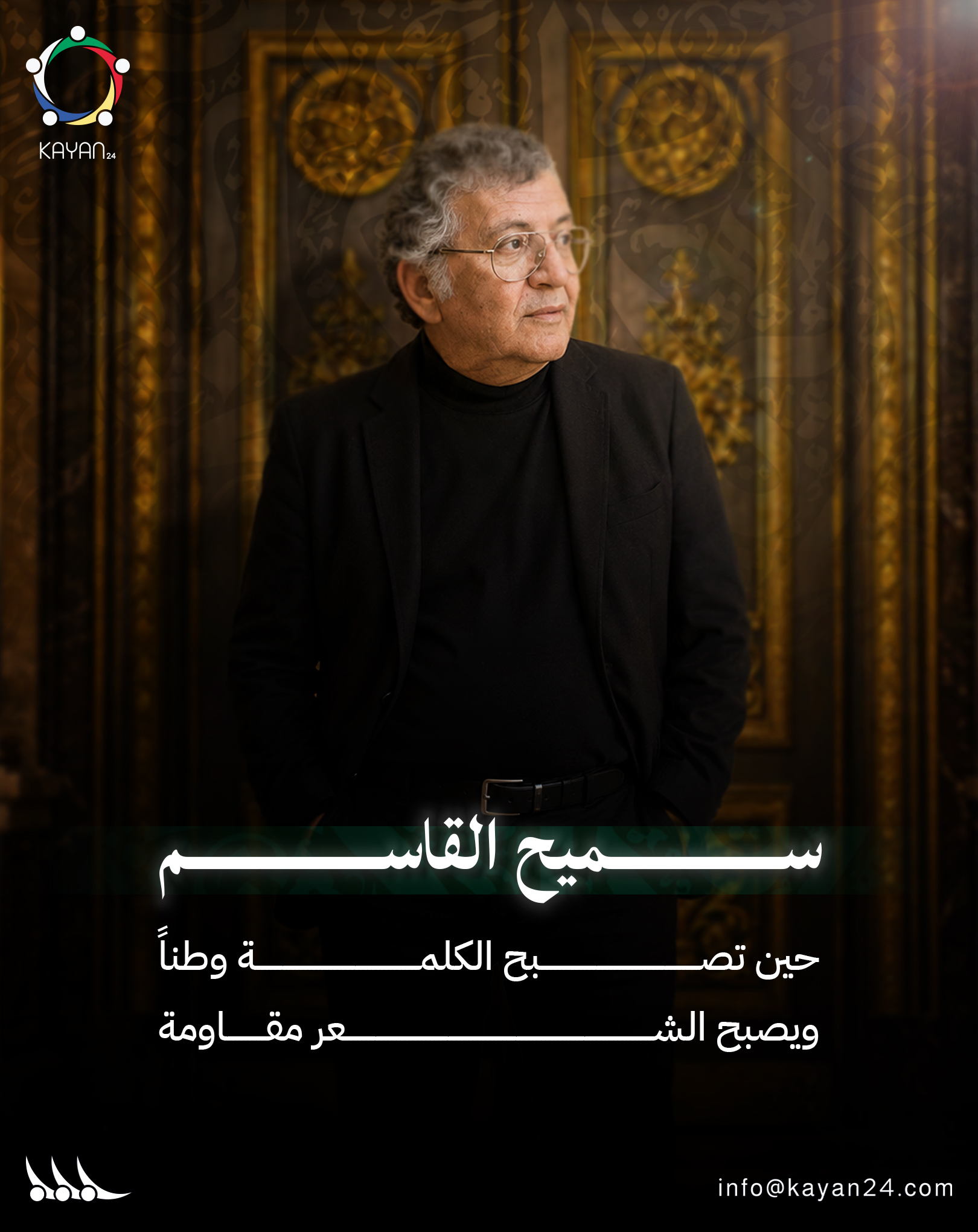
Al-Qasim hailed from a Palestinian Arab family belonging to the Druze community, and throughout his life, he embodied a shining model of Arab citizenship steadfastly attached to its land. He was among the first young men who courageously rejected mandatory conscription imposed by Israeli authorities on members of his community, paying the price for this noble stance through imprisonment, persecution, and house arrests that only hardened his resolve. Together with his lifelong companion, the poet Mahmoud Darwish, Al-Qasim formed the backbone of resistance literature and Palestinian revolutionary poetry within the 1948 territories.
His voice and poems became closely intertwined with composer Marcel Khalife, turning his verse into an icon of dignity and steadfastness memorized by heart across generations: “Upright I walk.. with head held high I walk.. in my palm an olive sprig.. and on my shoulder my shroud.. and I walk, and I walk…”.
Samih al-Qasim passed away in 2014 and was laid to rest in his village of “Al-Rameh” in the Galilee. Yet, he left behind a vibrant poetic and activist legacy extending from the Galilee to As-Suwayda, and from the Ocean to the Gulf—bearing witness that the free word never dies, and that Arab identity is a compass that never loses its way.