

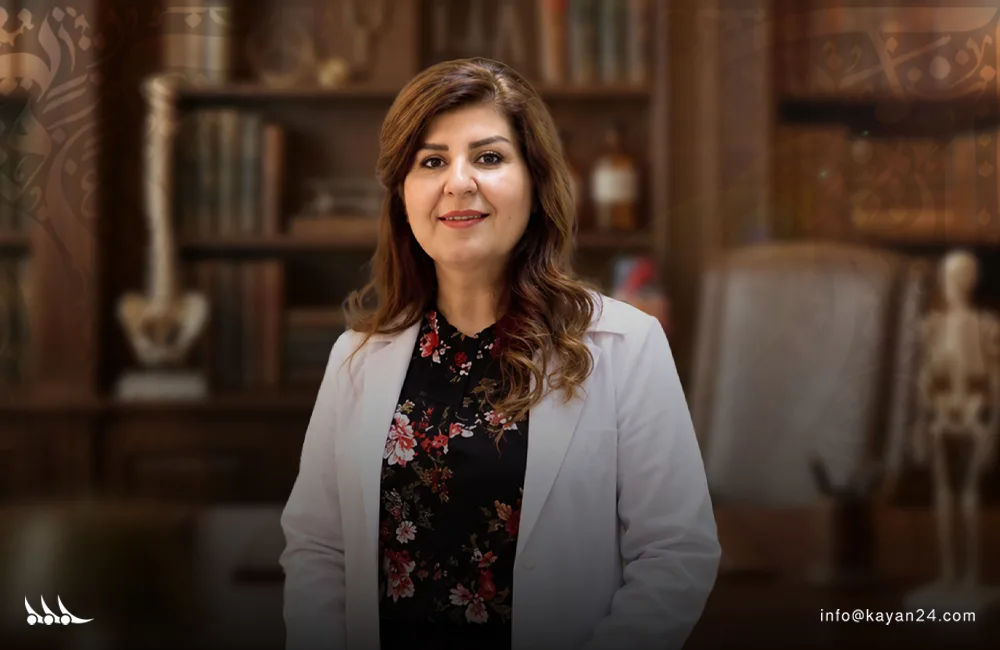
When passion transforms into a mission, medicine is no longer just a taught science or a fleeting touch of healing, but becomes a practice filled with humanity and a light restored to eyes exhausted by waiting. In the journey of Dr. Omaia Shibli Junod, challenge blended with a sincere desire to give; from her humble environment in the village of "Salkhad," her dream emerged to become the first girl to pursue education and the first doctor to open doors for generations to come. She did not settle for obtaining a Master's degree in microsurgical ophthalmology and phacoemulsification, but made her career an ethical duty and a humanitarian pulse, always striving to transfer the latest knowledge and medical developments to her community, so that healing becomes close to every eye seeking light.
Dr. Omaia is considered one of the pillars of medicine and scientific leadership in As-Suwayda Governorate, and one of the prominent names associated with innovation and continuous development in the field of eye surgery and treatment. She began practicing medicine in 1997, adopting constant follow-up of conferences and scientific research as a firm approach, with the goal of alleviating the travel burden on the people of the governorate. In 2003, along with a group of local doctors, she introduced retinal imaging and Argon laser treatment devices, and she was a pioneer in using intravitreal Avastin injections. In 2007, she participated with three other doctors in providing the first phaco machine in the governorate for modern cataract surgeries after completing an intensive training course in India under the inventor of the Wood Cutter technique.
These achievements culminated in performing the first intracorneal ring implant procedure to treat keratoconus in As-Suwayda in mid-2011, always keeping in mind the introduction of the latest technologies, such as the LASIK device, to serve her community, remaining a model for a doctor who sees continuous development as a humanitarian duty and a noble mission.