

Written by Marwan Muhammad Darwish:
During the events of the 1958 revolution, the Gendarmerie commander in the Bekaa summoned the then-Mukhtar of Baaloul, the late Abu Fawaz Othman, and asked him to cooperate and work to prevent the Druze rebels traveling from the Rashaya region to Moukhtara from passing through the lands of the town of Baaloul.
The Mukhtar, Abu Fawaz, replied: “How can we stop them, if the road they are traveling on in our village is called the “Druze Road”?
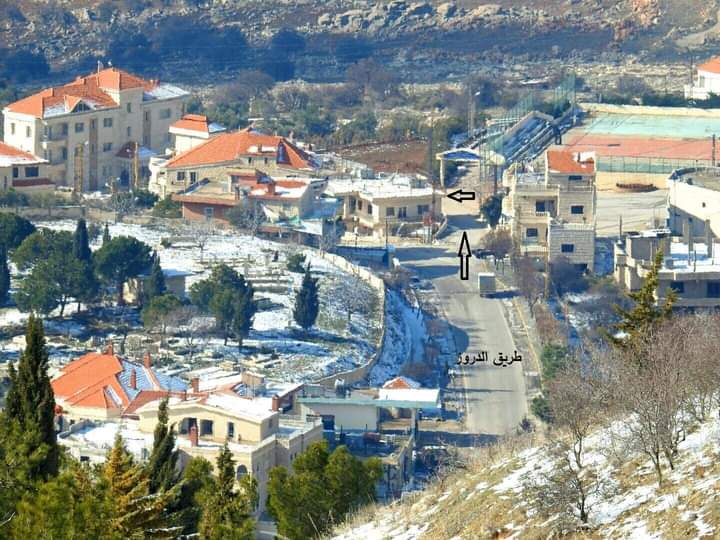
So where is that road located, and when was it given this name?
The Druze Road in Baaloul is the main external road extending from the entrance of the village at the Muallim garden towards the public school, the club, and the municipality, descending towards the castle in the direction of Saghbine. In days of old, it was narrow, with a width equal to a beast of burden carrying sheaves of harvested crops. There were no houses on its sides or surroundings as there are today, but rather all of it was vineyards, walnut trees, and fig trees.
In the middle of the eighteenth century, while Sheikh Ali Jumblatt was in Ba'daran, a delegate from the Vali (Governor) of Acre came to him asking him to lend the Vali thirty thousand piasters to assist him in his urgent travel to Istanbul. He gave him the money and refused to take a promissory note for the amount. The Vali was impressed by the Sheikh’s generosity and nobility.
When the Vali completed his preparations and set out for Istanbul by land through the Bekaa Valley, he began to ask about the village of Sheikh Ali and which village in the Bekaa it was equal to. Upon his arrival at the lands of the village of Khirbet Qanafar, it was said to him: “It is roughly equal to this village.” The Vali dismounted from his horse and turned towards the west, saying: “Peace be upon you, Sheikh Ali.” Then, after casting his gaze over the vast plain cut by the Litani River, he continued, “By God, if luck favors me and I return as Vali of Damascus, I shall place this fertile plain under the charge of Sheikh Ali and make its revenue his for as long as God wills.”
After reaching Istanbul, he was appointed Governor of Damascus. Upon his return to Damascus, he invited Sheikh Ali Jumblatt to him, honored his arrival, revered and respected him greatly, and asked him to record the names of the villages he wished to hold as concessions so that he could draft an official deed for him.
Sheikh Ali recorded the names of all the villages of the western and eastern Bekaa from the Anjar bridge to the Barghaz bridge, and they all entered into his concession.
When Sheikh Ali returned to the Chouf and the Druze clans learned what had happened in Damascus, they began flocking to him, asking for a share of the spoils. He granted the Al-Imad family the villages of Jub Jannine and Kamid al-Lawz; the Al-Nakad family the village of Aita al-Fakhar and the land of Jub Jannine; the Al-Abu Alwan family the village of Ghazzeh; the Al-Abd family the village of Tell al-Akhdar; the Al-Atallah family the village of Qabb Elias; and the Al-Talhouq family the villages of Qabr Abbas and Al-Mansoura. He kept for himself the villages of: Baaloul, Qaraoun, Lala, Midoun, Lousa, Ain al-Tineh, Machghara, Aitanit, Ain Zebdeh, Khirbet Qanafar, Ammiq, Qalya, Libbaya, Zallaya, Sahmar, Yahmar, Al-Shumaysa, Al-Muhayditha, Majdal Balhiss, Jarn al-Nahas, Azzeh, Al-Dakhweh, and Khiara Mazloum. He managed the affairs of these villages in the best way and built houses, barns, and stables for the farmers who began to flock to them from various parts, especially from the Ghouta and Baalbek regions.
Later, Sheikh Bashir Jumblatt built a retreat for himself on one of the hills of Baaloul, where the Jumblatt Sheikhs would spend most of their summer time.
In his endowment deed (waqfiyya) which he drafted and registered in 1808, and among his properties which he bequeathed as a religious endowment, Sheikh Bashir Jumblatt endowed: “Al-Hawa field, Mahmoud field, and the Khallat Baaloul tract located in the aforementioned area, which includes what the previous ones included, and its fame makes definition unnecessary.” However, this endowment was not recognized until the year 1866, the date his sons appeared before the Great Court Council in Mount Lebanon seeking to implement it, which was hindered by political shifts. Baaloul and the rest of the Bekaa villages remained in the possession of the Jumblatt family until the events of 1860.
In those days, Baaloul was the closest passage between the Hauran Mountains and the Chouf, and it was necessary for caravans or individuals traveling from the Hauran or the Rashaya region to the Chouf mountains, or vice versa, to pass through the village of Baaloul; thus, the road they traveled on in the village was called the “Druze Road.”
During the events of the 1860 strife, the Druze coming from Syria and the village of Deir al-Ashayer towards the Chouf had to pass through the village of Al-Rafid and descend from it to Baaloul on their way to Ain Zebdeh and then to Moukhtara. Therefore, they were effectively obliged to traverse this road in Baaloul and use it as a resting station before continuing their journey, which is exactly what happened later during the 1925 revolution and the 1958 revolution.