
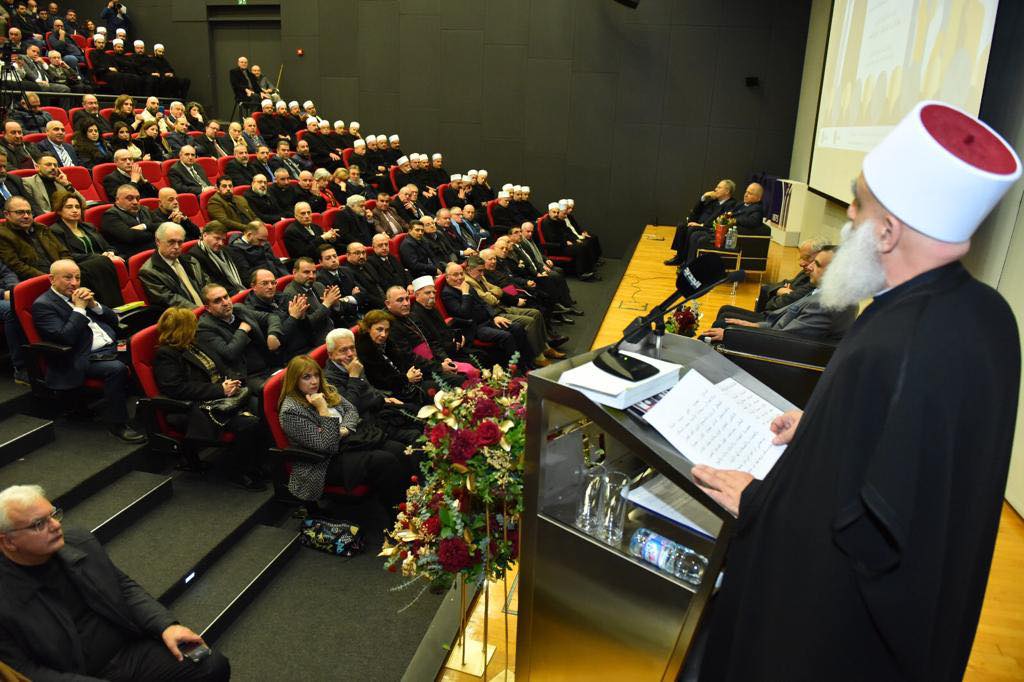
An honoring ceremony was held at the Institute of Islamic-Christian Studies in the Faculty of Religious Sciences at Saint Joseph University in Beirut for the Minister of Education and Higher Education, Judge Abbas Halabi, marking the launch of his dialogical biography in the book "The Adventure of Dialogue" by Dr. Antoine Ephrem Boustany. The event saw the participation of the Sheikh Akl of the Druze Unitarian Community, Dr. Sami Abi Al-Muna, along with a host of representatives of spiritual authorities, ministers, deputies, ambassadors, and spiritual, social, educational, cultural, and media figures.
Following speeches by the University President, Dr. Salim Daccache, former Minister Tarek Mitri, member of the Islamic-Christian Dialogue Committee, Mr. Mohammad Al-Sammak, the book’s author Dr. Salameh, and the Institute's Director, Dr. Roula Talhouk, with media personality Aldiko Elia as moderator, His Eminence the Sheikh Akl delivered a speech in which he said:
Your Excellencies, Eminences, and Virtues, Your Excellencies and Honors, Reverend Father Dr. Salim Daccache, President of the University, Ms. Roula Talhouk, Director of the Institute of Islamic-Christian Studies, His Excellency Mr. Tarek Mitri, the reliable man of profound thought, walking quietly on the paths of peace and moderation, His Excellency Mr. Mohammad Al-Sammak, the composed thinker and trusted reference for those of dialogue, and the perpetual recipient of prestigious awards, Dr. Antoine Ephrem Salameh, the esteemed author of the book and speaker of honest, expressive words, Deans, professors, fathers, sheikhs, scholars, friends, and beloved ones…
It gives me great pleasure to return to the podium and halls of Saint Joseph University from my position of responsible authority, having spent six years among its ranks and halls as a student embraced by the affection of the Institute of Islamic-Christian Studies family. I laid the first cornerstone for dear unitarian brothers who were encouraged and motivated to embark on the adventure of dialogue led by Mr. Abbas Halabi. We were among its sincere advocates since we turned the page on war and conflict together and opened ourselves with all our essence to a culture deeply rooted in the souls of our pure sheikhs, our authentic Ma'roufi heritage, and our honorable unitarian path.
Perhaps the best way to begin in the presence of the people of faith, knowledge, and dialogue is with a prayer from the heart: O God, bless our gathering and our university, grant us the care and ability to carry the message of love, mercy, and brotherhood, and to spread the culture of dialogue and peace. Guide us, O God, to the right path and help us rise on the road of religion and virtue, and to preserve human dignity and safeguard homelands. O God, illuminate our paths and guide our steps so we may speak the good and honest word, the one we learned from the pure Prophets of God and our sacred revealed books, the meanings of which we have accumulated in our institutes, meetings, and conferences over decades.
It is my pleasure today, brothers and sisters, to be present at a tribute seminar for one of our most prominent, shining dialogical figures, the representative of the Druze Unitarian community on the National Committee for Islamic-Christian Dialogue, His Excellency Minister Abbas Halabi, who truly expresses the openness of his unitarian environment to dialogue. He has been a struggler for its sake since his early youth, deepening his understanding of the subject locally, regionally, and internationally, and serving as the most prominent contributor to spreading its culture within his own Druze Unitarian community, among their sheikhs, youth, institutions, and intellectuals.
With Mr. Abbas and his distinguished colleagues, we observed and became certain that the Islamic-Christian coexistence in Lebanon has a "special flavor" that characterizes its citizenship. For the unique role of Lebanon is not limited to "the beauty of its geographical nature," as our veteran professor once said, but rather to "it being a laboratory and a pioneering center for Islamic-Christian dialogue, and a model to be emulated in our world." We realized with him that this "dialogue of life" and the inevitable relationships between the Lebanese "need constant work and active dynamism in an effort to purify them from the impurities of the past… and to expand commonalities at the expense of particularities, without eliminating them under the title of fusion," as he alluded to in his book "Interfaith Dialogue." This is what we have been accustomed to saying along with him: the dialogue of life requires acquaintance, respect, sharing, and openness, not disregard, cancellation, hegemony, and polarization.
How often our friend hoped, and we hoped together, that dialogue would gain the state's attention and not remain confined to the intellectual elite, that is, if the state "assumes its responsibility and settles the matter regarding the relationship that must exist between religious affairs and public affairs," as his comrade of the path, the man of good and influential words, Prince Hareth Chehab, sees in his book "The Last Fortress." We call for spreading the culture of dialogue in schools, universities, the media, and forums, and we talk about the importance of establishing a ministry or a high official authority to sponsor national reconciliation and dialogue, and about a change in the political system, moving towards the abolition of political sectarianism and the establishment of a Senate. Perhaps this would be the appropriate framework for this dialogue and for preserving the coexistence it aims for—something that is now time to achieve—where the basic sects are represented, serving as a source of reassurance for them, and where loyalty to the homeland is the basis for building the state. Regardless of how legitimate and influential external affections may be, we should not mix religion and politics in the blatant way that happens, which divides national loyalty into two: one to the state and homeland, and the second to the sect or sectarian party.
Just as we cannot separate reality from history—and Judge Abbas Halabi recited to us with his customary frankness his reading of the stages of this history, from the time of his ancestors, the Tanukhids and the Ma'ans, to the Shihab rule and the subsequent conflicts, interventions, frictions, offenses, and rivalries—we also cannot separate Lebanon from its mission-based truth, which has been reaffirmed and returned stronger and brighter after every critical stage and collision incident. "Lebanon, even if sometimes weaker than the deluded imagine, has always been stronger than many believe…," he says, concluding that those historical milestones or experiences proved "that assaulting the rights of sects, marginalizing one of them, or making deals at their expense is considered a leap into the unknown and will not survive." This is because respecting history, heritage, and coexistence is the foundation for the unity and survival of the homeland. This is what we have said and continue to say; the Lebanese are in need of understandings and settlements, for there is no escape or avoidance of living together. The national components exist and are indispensable, and it is more appropriate to consider their concerns and respect their history and position. Everyone must respect everyone; whoever thinks of eliminating the other is eliminating Lebanon, as has been said. Every sect, every party, and every component must strive to preserve its partner, because the golden rule for preserving the Lebanese formula dictates that each partner must strive to preserve their partner in citizenship, not just themselves.
Abbas Halabi has represented this sophisticated national unitarian thought, just as he has represented his unitarian community in the best possible way. He was a unifier and a binder in the National Islamic-Christian Dialogue Committee, in the Arab Dialogue Team, and in all local, regional, and international forums. He realized that his unitarian community was likewise a unifier and binder, and that the Druze Unitarians have no obsession other than the establishment of a just state that embraces religious diversity—a state of citizenship, interaction, integration, and partnership, not a state of bullying, conflict, and sectarianism. This is what the people of dialogue have focused on, at the forefront of whom is Mr. Abbas Halabi, who inspired his unitarian brothers with the role placed upon their shoulders, saying in his book "The Druze Unitarians: Culture, History, and Message": "The Druze Unitarians have a pioneering role, not only at the level of dialogue between Islamic and Christian sects, but also at the level of internal Islamic dialogue, in order to dispel concerns, doubts, and factors of caution and fear, by recognizing particularity and the legitimacy of diversity and difference." This is what we emphasize and what we have been working to strengthen since we assumed our duties and opened wide the door of cooperation and meeting with our brothers, the heads of Christian and Islamic sects, to play a role that aligns with our peaceful national nature, our enlightened unitarian thought, and our rational Islamic identity.
This approach, stemming from the core of our unitarian path based on serenity, peace, and rising above selfishness and hatred, is what we have reaffirmed repeatedly, considering what Mr. Abbas considered in his book "Interfaith Dialogue: The Arab Situation and the Lebanese Model," that "the Druze Unitarians are entrusted with an ancient spiritual and moral heritage, and if it was their destiny to establish Lebanon of the mission at the beginning of the seventeenth century, they are now required to renew the meaning of Lebanon as a pluralistic society." We realize with him that living together "is part of Islamic faith and Christian faith," and that its practical affirmation requires challenge and initiative, not cowardice and defeatism, as Lebanon of the mission is "difficult but possible," and "dialogue, even if arduous and long, is the only way to make the difficult Lebanon achievable," as Abbas Halabi and his adventurous dialogical comrades say, confident in the victory of truth no matter how high falsehood rises and tyrannizes.
Dear Minister, we are proud of you because you took risks for the sake of Lebanon and humanity, struggled for the sake of the role and the message, and strove to open the way for the children of your community and your homeland to engage in the path of dialogue. This path had its gentle spiritual thought established for us by pure, venerable sheikhs, and its deep philosophical concepts were explained by great thinkers, led by Kamal Jumblatt in "Beyond the Letter," Sami Makarem in his sophisticated enlightened literature, and others among the masters of thought and openness. Therefore, we saw you consolidating those pillars with faith, commitment, and an unparalleled presence, directing calls to your Druze Unitarian kin, before others, to emerge from the concerns of history, saying to them: "You are at the forefront of those who believe in the permanence and finality of Lebanon, and that it belongs to all its children on an equal footing. Do not seek to prioritize closure and extremism; rather, contribute to supporting your open thinking, your national awareness, and your moderate role, and do not retreat."
If we believe in what Mr. Abbas and his comrades in the Arab Dialogue Team believed, that the principle of dialogue is "acceptance of the common and cooperation on its basis, and acknowledgement of the different and dialogue regarding it," then why do some of us not accept each other? Why do we not understand the concerns of others and not hear the loud voice warning against being dragged into the swamp of death and the abyss of destruction? Why do we not excuse those who differ with us in opinion and position? Instead, we make treason and insult the language of communication, interaction, and attraction. We are confident that everyone wants Lebanon, the strong and healthy homeland, but they do not acknowledge difference and do not cooperate on the common. Therefore, we have said with the people of faith and moderation that the mission of dialogue is worth the adventure, that the biography of the adventurers is worth documenting, and that what our esteemed institute and our ancient university are doing deserves commendation. We, from our position, bless this biography and that journey, and we will remain committed to our message and our pursuit, recalling what we have learned and what we have taught, and reminding of some of what we have said in poetry, and what those dialogical figures have woven in prose, expressing the essence of this interesting, missionary adventure:
My Unitarian brother, be a fire on a banner
Wheat and a spear, and be like the cedar on the peaks
Lebanon is our reference, Lebanon brings us together
In affection, morals, and values
We are Lebanon, and this East is our dwelling
Cradle of religion and monotheism from ancient times
It is a message, more fulfilling than its area
And we are the messengers of faith among the nations
Whenever we differ, we diversify; that is richness
The root unites, and the branches are held high
Our heritage is one, and life is shared
And the blessing of love has surpassed all other blessings
May God protect and guard you with His eye of care, and may your institute remain a podium resounding with the good word, and may your educational mission be a source of new dialogical faces. May you endure, may your giving endure, and may Lebanon of the mission endure.
In conclusion, the honoree, Minister of Education Judge Abbas Halabi, delivered a speech thanking His Eminence the Sheikh Akl, the university, the speakers, and the participants, and presented him with the book "The Adventure of Dialogue" - The Dialogical Biography of Judge Abbas Halabi.