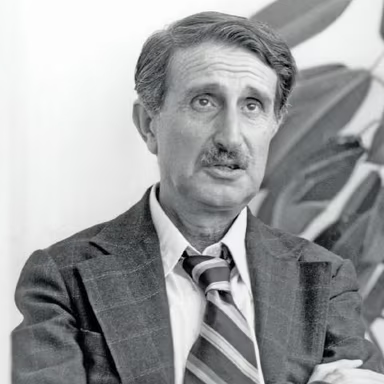

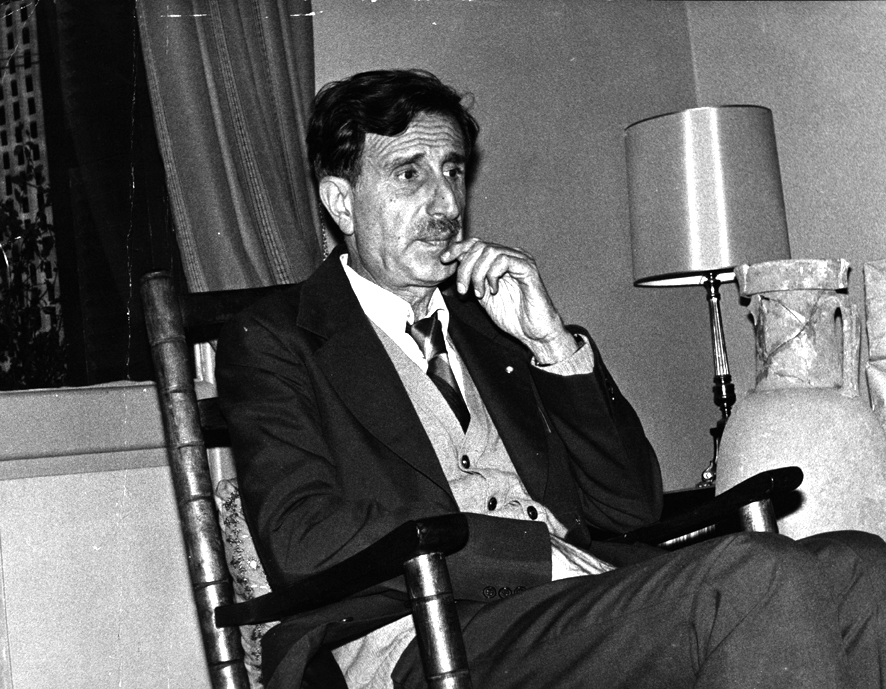
Kamal Jumblatt was born on December 6, 1917, and was one of the most important leaders of the Druze community in Lebanon, in addition to being a thinker and philosopher.
He was the leader of the National Movement in Lebanon at the beginning of the Lebanese Civil War, one of the founders of the Progressive Socialist Party, and is considered one of the Lebanese figures known for their support of the Palestinian cause. He was assassinated on March 16, 1977, and was succeeded in his leadership by his son, Walid Jumblatt.
Kamal Jumblatt is considered one of the most important political leaders in Lebanon and the Middle East in the twentieth century. He was known for his national positions and his advocacy for the Palestinian cause in all forums. Kamal Jumblatt was a distinguished scholar with great encyclopedic culture and the author of many works.
The Early Life of Kamal Jumblatt
Kamal Jumblatt was born in the town of Moukhtara in the Chouf District of Lebanon. He was a descendant of a family that inherited leadership, fame, and wealth. His father, Fouad Bey Jumblatt, was assassinated on August 6, 1921, and was the Qaim-maqam (district administrator) of the Chouf District during the French Mandate over Lebanon.
Jumblatt's leadership heritage did not come from his father Fouad alone; his mother, Nazira Jumblatt, was chosen by the Jumblattis as their leader to speak on their behalf after her husband's death. She resided in the Moukhtara Palace and was able to balance her role as a mother, who had to care for her two children, Kamal and Linda—she had another daughter named Leila who died of fever at the age of four—and her political role, which allowed her to be the ruler who filled the void left by her husband. She was able to influence the Druze and gain the satisfaction of the majority, drawing her strength from her strong relationship with the French.
Kamal Jumblatt received his primary education at the hands of a private tutor in Moukhtara named Marie Ghrayeb from Damour, who was a graduate of the Franciscans. He then joined the Lazarist Fathers' Institute in Keserwan in 1926, based on the advice of Bishop Augustine Boustany, a close family friend. He obtained his elementary certificate in 1928 and remained at the institute until 1937, accompanied by his personal servant who took care of his affairs and was always with him.
Jumblatt hated politics and wanted to study engineering, but the final word belonged to his mother, who wanted to prepare him for politics. She sent him to study law at the Sorbonne University in Paris in 1938. He also joined institutes for philosophy, psychology, and sociology there, earning degrees in those disciplines. However, the outbreak of World War II forced him to return to Lebanon to continue his law studies at the Saint Joseph University.
Kamal Jumblatt's Personal Life
Kamal Jumblatt married May, the daughter of Prince Shakib Arslan, on May 1, 1948. She was a woman of high culture, and they had their only child, Walid, on August 7, 1949.
Facts about Kamal Jumblatt
- He began writing poetry in both Arabic and French at the age of sixteen.
- He had an inclination towards mathematics and applied sciences such as algebra, geometry, and physics, and intended to specialize in engineering and travel to African countries to contribute to their development.
- It was his dream to become a doctor, and when that was not possible, he discovered medicine from another perspective by learning about herbal medicine, especially wheatgrass. During his stay in France, he studied under the sociologist Gurvitch, with whom he completed his degree in sociology.
- He established a chemical laboratory in Moukhtara, cast the laboratory machines himself in Lebanon, and installed them himself. It is mentioned that he invented a machine to convert chlorine gas and dissolve it in water. He taught economics at intervals at the Faculty of Law, Political Science, and Economics at the Lebanese University starting from 1960.
- He was fluent in three languages: English, French, and Arabic, and was familiar with Hindi, Latin, Spanish, and Italian. He read the Quran, the Bible, the Torah, the books of Tawhid, and the Indian Veda-Vedanta, and was known for his appreciation of Sufism.
- His sister, Linda, the wife of Hikmat Jumblatt, was assassinated in her home in Beirut on May 27, 1976, less than a year before his own assassination.
The Assassination of Kamal Jumblatt
He was assassinated on March 16, 1977, along with his companions Fawzi Shadid and Hafez Al-Ghossaini, at the entrance to the town of Deir Dourit in the Chouf, near a checkpoint of the Syrian army operating under the Arab Deterrent Forces. The car that carried out his assassination had an Iraqi license plate.
Kamal Jumblatt was a great speaker in international forums. He would appear before the masses carrying many causes. He believed in science as a solution to the problems of the Third World peoples and traveled the world to explain his cause and support it. He also inspected Palestinian camps in Lebanon from time to time and was awarded the Lenin Peace Prize. He traveled to India on a religious journey. He has many works in philosophy and politics, including "Luminous Horizons," "The Philosophy of the Transcendent Mind," "The Philosophy of Change," "Dialectics," "My Wishes for the Human of Tomorrow," "Philosophy and Yoga in the Land of the Sages," and "Texts on Economic Systems."
Kamal Jumblatt's Achievements
- Jumblatt formed a consumer cooperative to save people from the destitution that befell them as a result of World War II. Among the things remembered about him is that in 1933, he formed a delegation with his companions to meet Father Charlotte and ask him to place the Lebanese flag on the tower of the Aintoura Institute instead of the custom followed in the monastery at that time, which was to raise the French flag on Sundays and holidays on the school's tower.
- He was pledged allegiance as leader in 1943 after the death of his cousin, Hikmat Jumblatt, immediately after the funeral ceremonies. He was only 25 years old. In the same year, he won the parliamentary elections and entered the political arena. He publicly declared his opposition to the French Mandate forces in Lebanon and his support for the independence government. Thus, Kamal Jumblatt charted a new political line that deviated from what was familiar in his mother's time, who was known for her strong relationship with the Mandate forces, her inclination towards the bourgeois classes, and her support for aristocratic families.
- After independence, Kamal Jumblatt continued his political line, emphasizing the need to preserve independence, and joined several ministries, participating in the government. In 1947, he began a phase of political opposition after discovering the depth of corruption, bribery, and chaos the country was mired in.
- On March 17, 1949, Kamal officially founded the Progressive Socialist Party. On May 1, 1949, he and his companions—Albert Adib, Farid Jubran, Sheikh Abdullah Al-Alayli, Fouad Rizk, and George Hanna—announced its charter. He declared that the party's goal is to strive to build a society based on true democracy, in which social reassurance, justice, prosperity, freedom, and peace prevail, and which believes in the human rights approved by the United Nations Charter, including in Lebanon.
- In 1951, he founded the National Socialist Front to fight internal corruption in Lebanon, then, in the name of the Progressive Socialist Party, he called for a conference of Arab socialist parties. The conference was held in Beirut in May 1951. He also represented Lebanon at the Congress for Cultural Freedom held in Switzerland in June 1952.
- Kamal Jumblatt continued his national, nationalist, and humanitarian stances from a firm, principled standpoint. In August 1952, he held a national conference in Deir al-Qamar under the name of the National Socialist Front, demanding that the President of the Republic, Bechara El Khoury, resign. In September of the same year, El Khoury resigned, and the head of the front, Camille Chamoun, was elected President of the Republic. However, he differed with him the following year because Chamoun did not adhere to the conference's resolutions or the front's program. After that, he founded the Popular Socialist Front in opposition to the era of Camille Chamoun in September 1953, participated in the conference of opposition Arab parties held in Beirut in September 1954, supported Egypt's struggle against the Tripartite Aggression in 1956, and contributed directly to the reconstruction of what was destroyed in Lebanon following the 1956 earthquake. He also led a massive popular uprising in 1957-1958, both politically and militarily, against the era of Camille Chamoun, who tried to link Lebanon to colonial alliances. In doing so, he relied on Abdel Nasser. Based on this uprising, he supported the election of Fouad Chehab as President of the Lebanese Republic in September 1958, and performed his duties as his aide, and subsequently as an aide to President Charles Helou until 1973.
- Kamal Jumblatt founded the National Struggle Front in 1960 and laid the foundation for the Front of Progressive Parties, Forces, and National Figures in 1965. He then represented Lebanon in 1966 at the Afro-Asian Solidarity Conference and headed a parliamentary delegation to the People's Republic of China. His position was firm regarding supporting Algeria in its struggle against French colonialism.
- When Israel launched its war on the Arab countries in 1967, Kamal Jumblatt stood by Egypt, Syria, and Jordan, and supported the just cause of the Palestinian people. In 1973, he headed the Arab Committee for the Commemoration of Gamal Abdel Nasser and was elected unanimously as Secretary-General of the Arab Front Participating in the Palestinian Revolution in the same year. In 1975-1976, he confronted the Zionist-isolationist conspiracy in Lebanon and led the struggle of the Lebanese National Movement, announcing a program for phased reform of the political system in August 1975 and the establishment of the Central Council of Progressive National Parties.