
Grace Al-Habr wrote in Al-Anbaa newspaper:
"Nature is humanity's mother," is how Lamia Al-Ali describes nature. Lamia, a city-born woman who moved to live in a Shouf village, has developed a close bond with nature. She loves her new lifestyle in the town of Bireh and speaks passionately about its richness in water, soil, and greens. "The town has more than 50 water springs," she adds, "I understand why its residents have stayed... it is keeping them working and producing."
From the land and nature, this farmer and entrepreneur sources ingredients to prepare meals for customers in a community kitchen in the town of Barouk, one of the villages in the biosphere of the "Al-Shouf Cedar Nature Reserve." Al-Ali explains that with the impacts of climate change affecting the nature, herbs, and plants that serve as the primary source for her work, finding some plants has become rare or non-existent, such as "borage or mullein."
Lamia Al-Ali's personal experience represents one of many initiatives undertaken by activists and environmental entities in Lebanon, such as the project she works with, "Cedar Projects." The idea, as its owners narrate, was derived from the concept of sustainability and the protection of nature, humans, and society. It is part of the expansion of the "Al-Shouf Cedar Nature Reserve" biosphere, which carries out various activities to try to address the challenges of climate change, despite having suffered severely from its effects over the past period. All these initiatives work to spread awareness about making human lifestyle and daily activities environmentally friendly and preservative of natural resources.
Ecotourism Initiatives
The scene of environmental protection and adaptation to climate change is not complete without humans. The human element is the cornerstone of the integrated protection and comprehensive development system, which is what the "Cedar Projects" project focuses on. Its owner, Cedar Mahmoud, says it started 7 years ago with the idea of a guesthouse and has now become a model for "sustainable tourism" in the town of Barouk.
Mahmoud emphasizes in an interview with "Al-Anbaa Electronic Newspaper" that the new generation's preservation of this heritage and protection of nature and the environment is completed by providing job opportunities and activating local economic movement, confirming that the social and economic impact of developing this model is very good and translated and proven by numbers, both now and in the future phase.
According to those in charge, the project has created job opportunities and become a destination for farmers, local producers, and residents of neighboring villages, whether through the project's work team from neighboring villages, cooperation with local producers as suppliers, or through the use of its community kitchen. Efforts are focused on expanding and developing the scope of work to support the sustainable tourism sector, and on keeping young people on their land and bringing them back by creating productive, long-term initiatives, in cooperation with donors, the local community, and institutions like the "Al-Shouf Cedar Nature Reserve." Mahmoud concludes: "Civilization is the correct image of the society in which we were born and raised and which we want our lives to continue within."
Role of Reserves at Risk
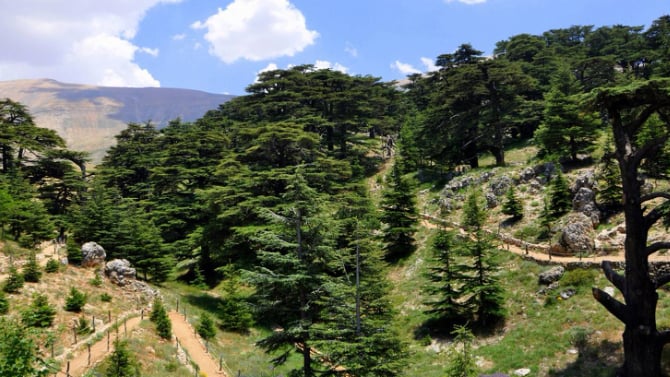
Nature reserves are considered very important in preserving the environment and ensuring biodiversity, and they are a refuge for many species of birds and animals. The "Al-Shouf Cedar Nature Reserve" is the largest in Lebanon and forms the last extension of Lebanese cedar to the south. In 2005, UNESCO declared it, along with 22 surrounding villages, a biosphere reserve. However, with the intensification of climate change, the reserve has suffered from numerous effects and repercussions. Its director, Dr. Nizar Hani, identifies the direct impact of climate change on the reserve and cedar forests in three scientific points in an interview with "Al-Anbaa".
First, the disruption of the natural reproduction of forests due to late snowfall, which leads to early germination of cedar seeds. Hani explains that the natural cycle of cedar germination begins with the fall of cedar seeds in October and November, and with the arrival of December and the rainfall and snow, they are preserved until early spring.
Second, the increase in the activity and number of insects present in cedar forests that have adapted to them. With rising temperatures and long periods of drought, these insects become active, especially since their natural enemies take more time to resist them, which directly affects the forests.
As for the third and most important impact, it is forest fires, especially in the Mediterranean basin due to long heatwaves that begin in late April and continue until the end of November, which imposes pressures on forests and biomass and increases forest fires.
Therefore, to overcome the repercussions of the mentioned challenges, Hani mentions several projects implemented by the reserve to protect nature and the environment, avoid fires, and protect the cedar forest, including biomass management, sustainable agricultural land reclamation, and the production of agricultural compost (organic fertilizer), in addition to wildlife monitoring and reintroducing the "mountain ibex" to the reserve.
One of the most prominent challenges of climate change is also the disparity in the timing of rainy days and its repercussions on economic sectors such as agriculture. In this context, field coordinator at the "Al-Shouf Cedar Nature Reserve," Najad Saad El-Din, explains to "Al-Anbaa" that monitoring stations in the reserve recorded 1550 mm of rain last season distributed over 73 days of the year, knowing that these quantities used to be recorded over more than 120 days or more for over ten years. During the 2023-2024 season, monitoring stations recorded 116 mm of rain in one day on January 22, 2024.
These numbers are recorded for the first time according to Saad El-Din, who adds: "We also noticed a delay in snowfall in the months of January and February, which leads to a faster melting process as temperatures begin to rise."
He explains that "the fall of large amounts of rain in a few days and the speed of snow melting negatively affect the soil's absorption of water, which means that groundwater levels do not benefit from this rain. Consequently, these large quantities of water go to rivers and the sea and can cause landslides and major problems at the level of soil and infrastructure."
These changes have prompted those in charge of the reserve to look for solutions to support farmers, according to Saad El-Din, including projects for water management and monitoring and managing agricultural ponds with modern, high-tech networks.
Investment Returns
It becomes clear in light of this difficult reality that trying to adapt to climate change from environmental, economic, and social aspects is not enough; rather, the most important thing is to preserve the environment and nature and protect biodiversity to save the human future and the sustainability of life with integrated elements. Here, the role played by nature reserves in developing a lifestyle model that motivates humans to face the challenge of climate change emerges, which the "Al-Shouf Cedar Nature Reserve" is working on along two parallel lines.
In this framework, Dr. Nizar Hani says that the first aspect is natural, by making the forest more adaptable to changes through rehabilitation activities, increasing reforestation, and mitigating forest fires. The second aspect is based on diversifying job opportunities and income by involving local communities in ecotourism activities, rural development, agriculture, capacity building, and environmental awareness. "We now have dozens, if not hundreds, of participants who provide various and different services that increase their income and contribute to developing and protecting the reserve and its surroundings."
Here, it is necessary to point out the significant economic return provided by protecting the environment and vital ecosystems, which is what countries strive for in preparing their economic and development strategies, as reserves form an essential part of them due to their pivotal role in developing regions and rural areas and increasing job opportunities.
This is proven by the numbers concluded by the last economic valuation study of the Al-Shouf Cedar Reserve prepared in 2015, which shows that investing one dollar in the reserve has economic returns of 19 dollars and that the annual returns of the reserve are estimated at 19 million dollars distributed to the state, local authority, local communities, and the reserve. Hani expects returns to rise during the current year to 27 dollars as a result of improved ecosystem services.
Initiatives are an Urgent Need!
"Individual development initiatives are an urgent need, and we rely on them to save the family's life and to give a chance and hope to young people," this is how Dr. Habouba Aoun, Director of Community Development Programs at the University of Balamand, describes the results of the role and impact of these initiatives on society, "especially since we do not have a development plan in Lebanon that includes all regions and segments of society," as she puts it.
In an interview with "Al-Anbaa," Aoun points out that individual and local initiatives show positive results and are an example of how to work hard, produce, expand, and develop the work of the individual and the group, and keep young people in their country, especially since the beneficiaries are from the youth category and housewives. Aoun commends entrepreneurship initiatives that give young people a chance to build an idea. "This idea, in turn, crystallizes into a project built on science and studies so that the causes of success are available to it."
As for the initiatives that reach women in their homes, they are very important, "especially for ladies who bear the responsibility of supporting their family or contributing to adding additional income." Aoun links surrounding the family with psychological balance and its reflection on physical health, "this is based on the direct relationship between the family's economy and stability, and mental and physical health."
New Global Trends... Where is Lebanon Among Them?
With the evolution of the repercussions imposed by climate change on human life, societies, and the environment, the priorities and approach of the international trend in protecting vital ecosystems and their diversity have shifted.
In this framework, the Convention on Biological Diversity, which entered into force on December 29, 1993, is considered the most important for reserves and preserving ecosystems, and its mission is to study the minimum area of reserves to ensure the conditions for human life and survival, according to Dr. Nizar Hani.
It is noted that the Lebanese government signed the Convention on Biological Diversity and then ratified it through Law No. 360 dated 1994. One of the goals of the convention was previously to protect 17% of the land and 10% of the sea, while today the new goal has become "30x30" for land and oceans. The new trend recommends the necessity of protecting 30% of land and 30% of the ocean by the year 2030, ensuring communication between these sites, involving local communities, and the fairness of applying protection with local communities.
Dr. Nizar Hani explains that reserves constitute 22% of Lebanon's area, and they include all reserves affiliated with the Ministries of Environment and Agriculture, the Hima, natural sites, and all sites subject to protection, hoping to reach the international goal in 2030. The "Al-Shouf Cedar Nature Reserve" constitutes 5% of the area of reserves in Lebanon, as it contains three zones: the core, the buffer, and finally, development, where 120,000 people live, distributed over 25 villages.
In this field, the "Al-Shouf Cedar Nature Reserve" is proceeding to expand the area of protection around the reserve, as its director says: "We added three villages to the reserve last year, and we are currently studying adding new villages to the reserve's biosphere."
In conclusion, adaptation to climate change is a challenge that requires solidarity, cooperation, and collaboration between official authorities, local bodies, and society as a whole. The experience of the farmer Lamia Al-Ali, who decided to venture into ecotourism and her insistence on relying on nature and its resources, is a living example of the human role in protecting nature and the health of society and its individuals. She is like the individual initiatives aimed at preserving the environment and achieving sustainable development, which, if accompanied by an integrated development strategy, will activate the economy in the long term and establish a civilized model of life.
This report was prepared within the "Media, Climate Change and Environmental Issues" project in cooperation between the Maharat Foundation and the Field Support Services Project in the Middle East (Jordan, Lebanon, and Iraq), implemented by Cowater International and funded by Global Affairs Canada.