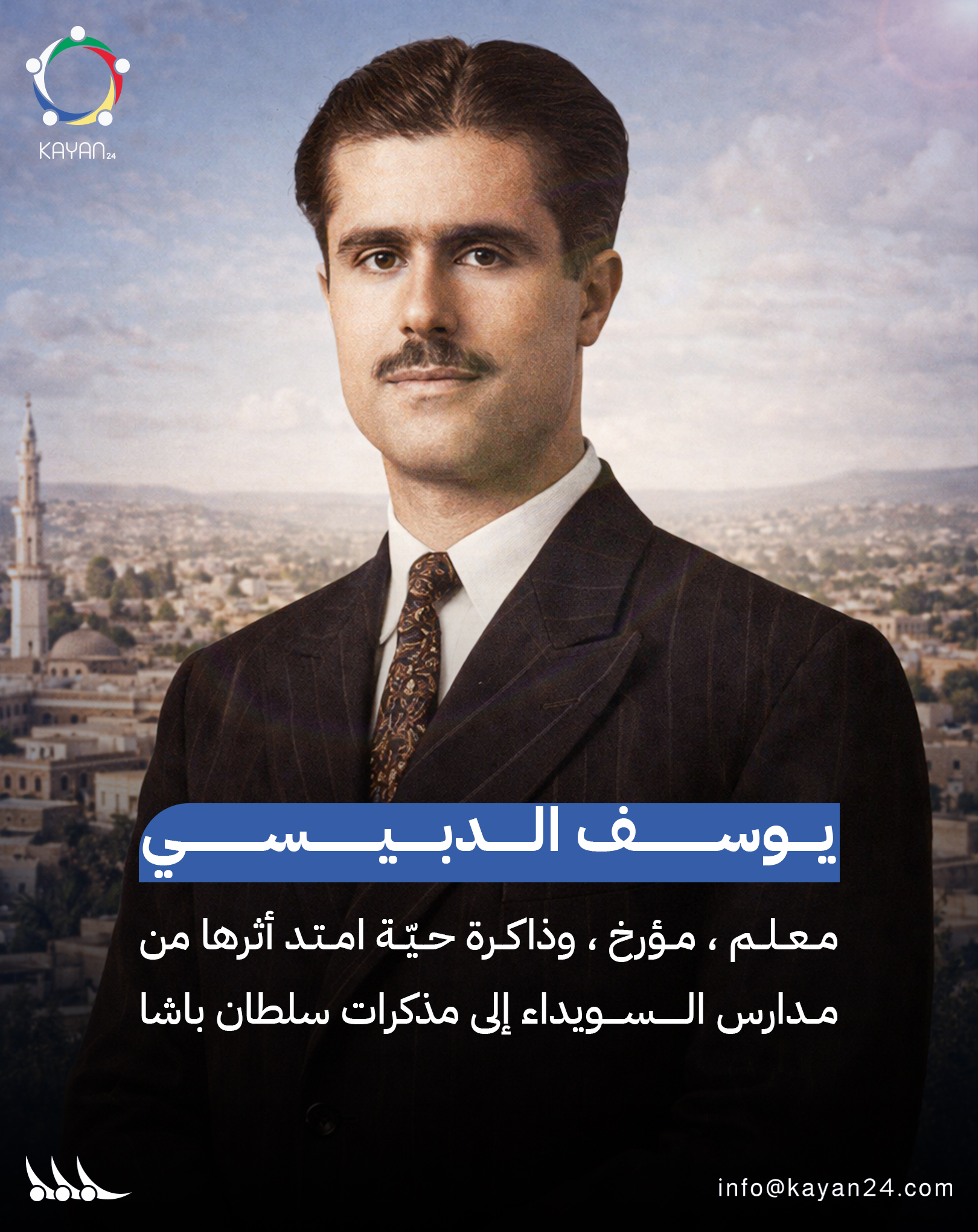

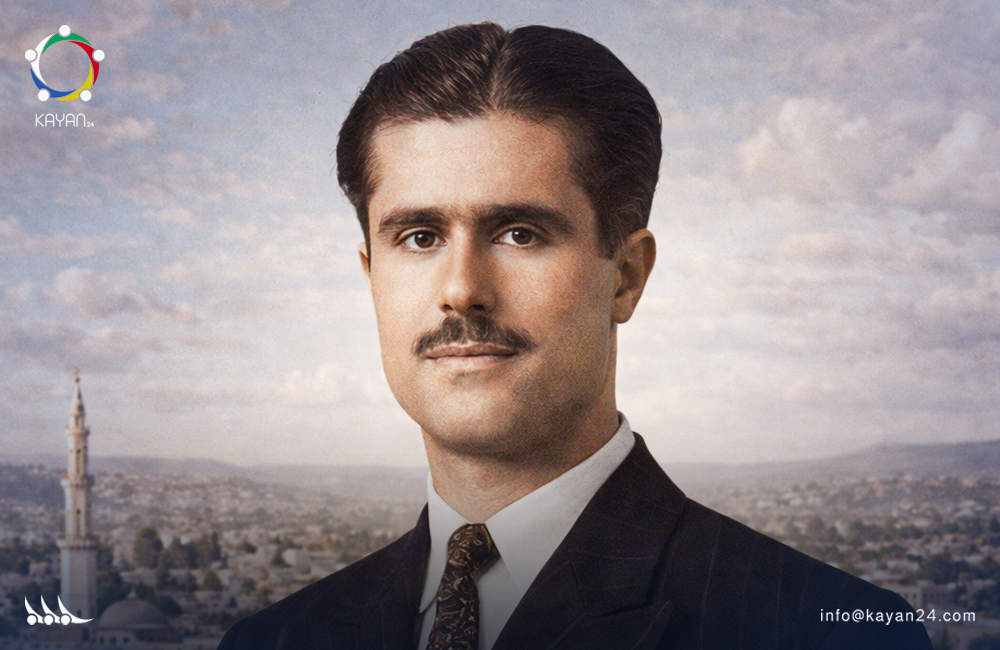
Between his birth in As-Suwayda in 1918 and his departure from it a full century later, Youssef Al-Dbaisi was not just an employee or a teacher, but a walking (memory).
Youssef Al-Dbaisi was born in As-Suwayda in 1918.
He received his primary education at the French Druze school there, mastered the French language, and worked as an interpreter and then as an employee at the Officers' Club in the 1930s.
He then worked as an interpreter in (Al-Mira), the institution that used to purchase wheat from farmers. When he and his superior, the Russian officer Stawkowski, discovered the thefts occurring through the weighing of wheat quantities, he was dismissed from his job, and his superior was transferred to Tartus.
After a while, he went to Tartus at the invitation of Stawkowski to participate in a competition for employment at Al-Mira, where he ranked first and won the job.
During this period, he was studying and obtained his Baccalaureate degree in both its parts in 1947.
He enrolled in the Higher Institute of Teachers in Damascus, and at the end of his studies in 1951, he obtained a diploma in education from the aforementioned institute and a degree in history from the Faculty of Arts at Damascus University.
He worked in teaching in As-Suwayda and then as a principal for several middle and high schools.
After the establishment of the Union, he was seconded to work at the Central Ministry of Education in Cairo, specifically in the delegates' section. There, he enrolled at Cairo University to complete his postgraduate studies and prepared a thesis titled (The Unitarian Druze), but the dissolution of the Union forced him to return to Syria to work as the principal of the Shakib Arslan High School.
In 1968, Sultan Pasha Al-Atrash entrusted him and his colleague, Mr. Salah Mezher, with writing his memoirs. He would dictate them to them in weekly sessions that lasted until 1974, and they would draft the memoirs and present them to the Pasha to review and sign every page of them.
Al-Dbaisi passed away in 2018, leaving behind five volumes on "The People of Monotheism" (Ahl al-Tawhid) and other works, for his name to remain synonymous with the man who not only wrote history but lived it with rare integrity.