

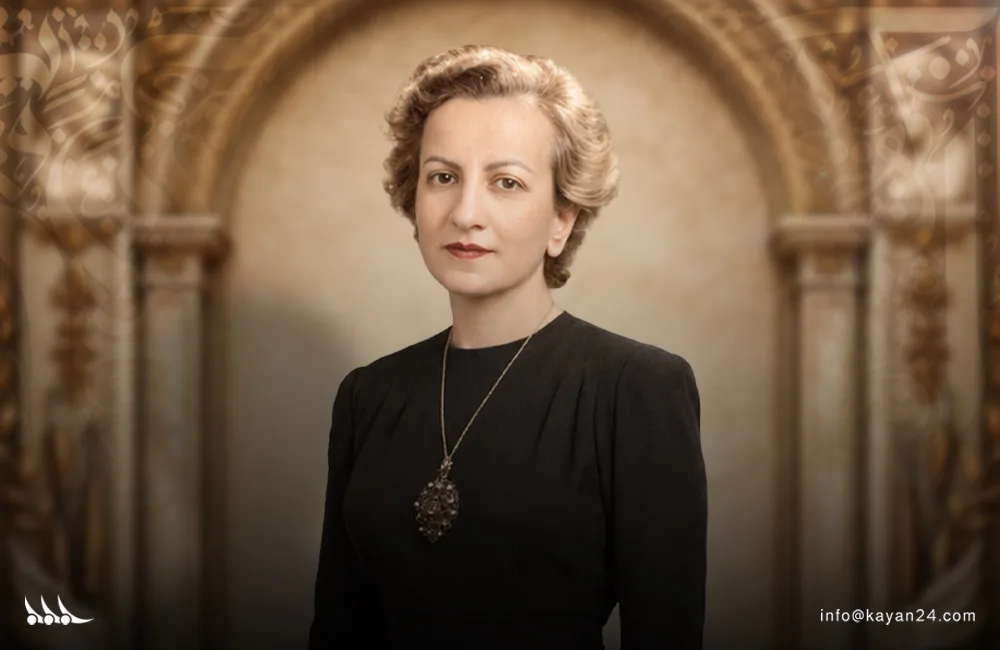
The historical memory of the Druze community preserves inspiring biographies of pioneering women who contributed with their wisdom and intellect to shaping the cultural and social landscape. At the forefront of these figures, Dr. Najla Mustafa Abu Izzeddin stands out as a bright symbol of leadership and excellence. She was a model of a woman who combined the authenticity of her Lebanese mountainous environment with outstanding academic and diplomatic contributions on a global scale. Najla carved her path with knowledge and steadfastness, serving as an ambassador for the thought of her community and nation, and achieving scientific and cultural milestones that made her a historical figure to be emulated.
She was born on May 22, 1907, in the Lebanese town of Abadiyeh to an established Druze family with a significant intellectual and social presence. Her father was the military physician and public health official Mustafa Abu Izzeddin, and her paternal uncles were the journalist Suleiman Abu Izzeddin and the judge Muhammad Abu Izzeddin. She began her educational journey at the American School for Girls in Beirut, then moved to Paris to study at the Lycée Racine, before crowning her first university studies by graduating from Vassar College in the United States in 1930. She continued her academic passion until she entered history as the first Arab woman to earn a doctorate in 1934 from the University of Chicago. During her university years, she presented qualitative specialized research; she addressed the subject of "Taha Hussein and the Dawn of Islam" in her master's thesis, while her doctoral dissertation focused on "The Racial Origins of the Druze."
Najla began her professional life by teaching anthropology at the Teachers College in Baghdad, marking another first by being the first woman to teach male students there. She also lectured at the American University of Beirut and served as the principal of a girls' school in Damascus. With the outbreak of World War II, she settled in London to conduct her historical research and contributed to the preliminary efforts to establish the Arab League. In 1945, she joined the staff of the League's office in Washington, D.C., and served as a delegate to the historic United Nations conference on the international organization in San Francisco.
During the 1940s and 1950s, she was active in giving lectures and seminars to raise awareness of Arab issues across the United States and Canada, especially after publishing her book "The Arab World: Past, Present, and Future" (1953) under the auspices of the American Friends of the Middle East organization. Her lectures targeted prominent women's and civil organizations such as the YWCA, the Daughters of the American Revolution, the League of Women Voters, and the American Association of University Women. Despite attempts by some organizations to hinder her media and public appearances, she continued her enlightenment mission with steadfastness, alongside exchanging scholarly correspondence with the researcher Alphonse Mingana.
She gained membership in the American Oriental Society in 1931 and crowned her national and institutional efforts by participating in the founding of the "Institute for Palestine Studies" in Beirut in 1963. She enriched the Arab and global library with a number of reference historical works, most notably: the book "The History of Ibn al-Furat" (1939 - two volumes, which she co-edited with Constantine Zurayk), the book "The Arab World: Past, Present, and Future" (1953), the book "Nasser of the Arabs" (published in French in 1975 and in Arabic in 1981), and the book "The Druze: A New Study of Their History, Faith, and Society" (1984, with its second edition published in 1993).
Dr. Najla Abu Izzeddin passed away in 2008 at the age of one hundred, after having written a luminous page in the history of the women's and scientific renaissance through her career. Her academic and diplomatic legacy remains a testament to the ability of Arab and Druze women to break through global horizons and to combine rigorous scientific achievement with loyal defense of their nation's causes and identity.